
Prevzaté z Forwardu
Pamätníky nacistických kolaborantov na Ukrajine
Ternopil a mnohé ďalšie mestá – Ďalšia socha Banderu v Ternopile. Vľavo hore je fotografia zo Žovkvy z roku 1941, keď členovia OUN vítali nacistov a pomáhali im pri vraždení Židov. Na transparentoch sú nápisy „Heil Hitler!“ a „Sláva Banderovi!“.
Ukrajina má niekoľko desiatok pamätníkov a desiatky názvov ulíc oslavujúcich tohto nacistického kolaboranta, čo by stačilo na dve samostatné stránky na Wikipédii (Banderovcov je toľko, že v tomto projekte je uvedených len niekoľko).
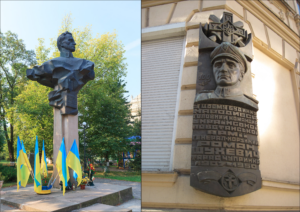
Krakovec, Ľvov a mnohé ďalšie mestá – Pamätníky Romana Šucheviča (1907 – 1950), ďalšej osobnosti OUN a nacistického kolaboranta, ktorý bol veliteľom pomocného práporu Nachtigall v nacistickom Nemecku, ktorý sa neskôr stal 201. pomocnou policajnou jednotkou Schutzmannschaft . Šuchevič neskôr velil brutálnej Ukrajinskej povstaleckej armáde (UPA), ktorá bola zodpovedná za masakrovanie tisícov Židov a 70 000 – 100 000 Poliakov.
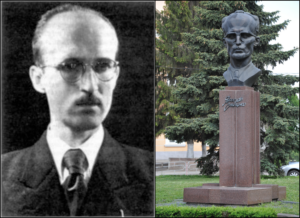
Pamätník v Krakovci (vľavo hore) a pamätná tabuľa vo Ľvove (vpravo hore) sú dve z mnohých Šuchevičových sôch na Ukrajine. Patria sem spoločné pamätníky venované jemu a ďalším nacionalistom vo viacerých mestách (pozri vyššie uvedený záznam o Banderovi), pamätník venovaný jemu a ďalším nacionalistom v Spryni ; pamätník, dve pamätné tabule a basreliéf na Národnej polytechnickej univerzite v Ľvove ; a pamätníky v Borščive , Ivano-Frankivsku , Kaluši , Chmeľnickom , Chuste, Kňahyničoch (a pamätná tabuľa ), Koločave, Oglejive , Šmankivckom , Starom Uhrynive (v múzeu Stepana Banderu), Tyškivtsyahu , Tyudive a Zabolotivke ; pamätné tabule v Bučači , Kamianke-Buzkej, Kolomyji , Pukive , Radomyšli , Rivne a Volji-Zaderevatskej; múzeum v Hrimne; štadión v Ternopile; stanica metra v Kyjeve ; a škola v Ivano-Frankivsku. Pozrite si The Algemeiner o tom, ako Izrael kritizuje pomenovanie štadióna v Ternopile po Šuchevičovi.
Ešte šokujúcejšie sú Šuchevičove pamätníky v Kanade a USA
Okrem toho je Šuchevič poctený niekoľkými desiatkami ulíc na Ukrajine (je ich toľko, že v tomto projekte je uvedených len niekoľko). Väčšina sôch Banderu a Šucheviča sa nachádza na západnej Ukrajine, v mestách, kde bolo židovské obyvateľstvo vyhladené paramilitárnymi jednotkami lojálnymi týmto mužom. Po Šuchevičovi bol pomenovaný aj hlavný bulvár v Kyjeve. Svetový židovský kongres odsúdil oslavu Šucheviča a sochy v Ivano-Frankivsku.
Od nástupu novej vlády v roku 2014 bolo postavených na Ukrajine mnoho nových ulíc a pamätníkov.
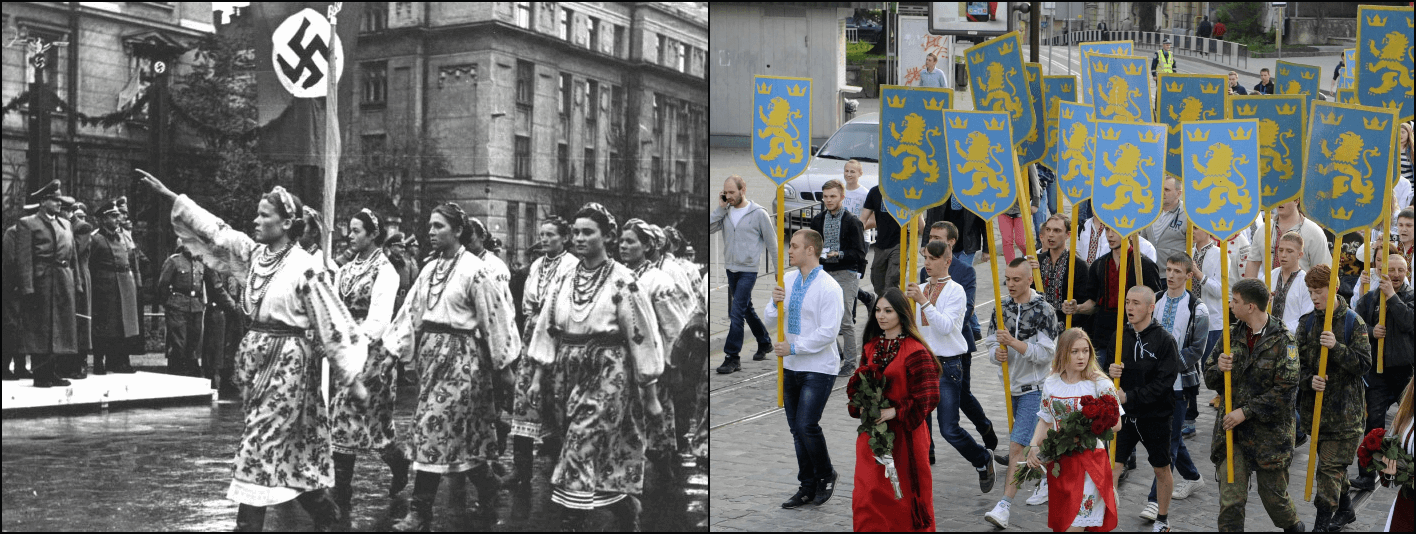
Vľavo: sprievod na počesť generálneho guvernéra Poľska Tretej ríše Hansa Franka, Stanislaviv (dnes Ivano-Frankivsk), október 1941 (Wikimedia Commons). Vpravo: pochod pripomínajúci založenie 14. granátnickej divízie SS (1. haličská), Ľvov, 28. apríla 2014 (Jurij Djačišyn/AFP cez Getty Images). Obrázok od Forward collage
Tento zoznam je súčasťou prebiehajúceho investigatívneho projektu, ktorý časopis Forward prvýkrát publikoval v januári 2021 a ktorý dokumentuje stovky pamätníkov po celom svete venovaných ľuďom zapojeným do holokaustu. Zoznam pre jednotlivé krajiny neustále aktualizujeme. Ak viete o niektorých, ktoré tu nie sú uvedené, alebo o sochách, ktoré boli odstránené alebo ulice premenované, pošlite e-mail na adresu editorial@forward.com s predmetom: Projekt nacistického pamätníka.
Poznámka: V rokoch od povstania na Majdane, ktoré prinieslo na Ukrajinu novú vládu v roku 2014, bolo postavených množstvo pamätníkov nacistických kolaborantov a páchateľov holokaustu, niekedy až tak často, ako každý týždeň. Vzhľadom na ohromujúci počet ulíc pomenovaných po Stepanovi Banderovi a Romanovi Šuchevičovi sú v rámci tohto projektu uvedené iba niektoré.
Vľavo: sprievod na počesť generálneho guvernéra Poľska Tretej ríše Hansa Franka, Stanislaviv (dnes Ivano-Frankivsk), október 1941 (Wikimedia Commons). Vpravo: pochod pripomínajúci založenie 14. granátnickej divízie SS (1. haličská), Ľvov, 28. apríla 2014 (Jurij Djačišyn/AFP cez Getty Images). Obrázok od Forward collage
Tento zoznam je súčasťou prebiehajúceho investigatívneho projektu, ktorý časopis Forward prvýkrát publikoval v januári 2021 a ktorý dokumentuje stovky pamätníkov po celom svete venovaných ľuďom zapojeným do holokaustu. Zoznam pre jednotlivé krajiny neustále aktualizujeme. Ak viete o niektorých, ktoré tu nie sú uvedené, alebo o sochách, ktoré boli odstránené alebo ulice premenované, pošlite e-mail na adresu editorial@forward.com s predmetom: Projekt nacistického pamätníka.
Poznámka: V rokoch od povstania na Majdane, ktoré prinieslo na Ukrajinu novú vládu v roku 2014, bolo postavených množstvo pamätníkov nacistických kolaborantov a páchateľov holokaustu, niekedy až tak často, ako každý týždeň. Vzhľadom na ohromujúci počet ulíc pomenovaných po Stepanovi Banderovi a Romanovi Šuchevičovi sú v rámci tohto projektu uvedené iba niektoré.
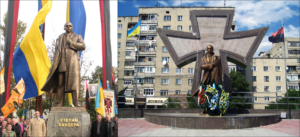
Vľavo: Pamätník Stepana Banderu, otvárací ceremoniál, Ľvov, 13. októbra 2007 (Wikimedia Commons). Vpravo: Banderov pamätník, Ivano-Frankivsk (Wikimedia Commons). Obrázok podľa koláže vpred
Ľvov a Ivano-Frankivsk – 1,5 milióna Židov, štvrtina všetkých Židov zavraždených počas holokaustu, pochádzalo z Ukrajiny . Počas uplynulých šiestich rokov krajina inštitucionalizovala uctievanie paramilitantnej Organizácie ukrajinských nacionalistov , ktorá kolaborovala s nacistami a pomáhala pri vraždení Židov, a Ukrajinskej povstaleckej armády (UPA), ktorá zmasakrovala tisíce Židov a 70 000 – 100 000 Poliakov. Významnou osobnosťou uctievanou v dnešnej Ukrajine je Stepan Bandera (1909 – 1959), nacistický kolaborant, ktorý viedol frakciu OUN (nazývanú OUN-B); vyššie sú jeho sochy v Ľvove (vľavo) a Ivano-Frankivsku (vpravo). Veľká vďaka patrí Perovi Andersovi Rudlingovi, Tarikovi Cyrilovi Amarovi a Jaredovi McBrideovi za ich usmernenia týkajúce sa ukrajinských kolaborantov.
Ľvov a Ivano-Frankivsk – 1,5 milióna Židov, štvrtina všetkých Židov zavraždených počas holokaustu, pochádzalo z Ukrajiny . Počas uplynulých šiestich rokov krajina inštitucionalizovala uctievanie paramilitantnej Organizácie ukrajinských nacionalistov , ktorá kolaborovala s nacistami a pomáhala pri vraždení Židov, a Ukrajinskej povstaleckej armády (UPA), ktorá zmasakrovala tisíce Židov a 70 000 – 100 000 Poliakov. Významnou osobnosťou uctievanou v dnešnej Ukrajine je Stepan Bandera (1909 – 1959), nacistický kolaborant, ktorý viedol frakciu OUN (nazývanú OUN-B); vyššie sú jeho sochy v Ľvove (vľavo) a Ivano-Frankivsku (vpravo). Veľká vďaka patrí Perovi Andersovi Rudlingovi, Tarikovi Cyrilovi Amarovi a Jaredovi McBrideovi za ich usmernenia týkajúce sa ukrajinských kolaborantov.
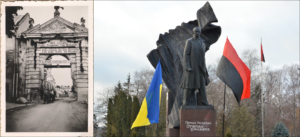
Vľavo: Hlynská brána ozdobená transparentmi vítajúcimi nacistickú inváziu na Ukrajinu, Žovkva, 1941. Horný transparent: „Heil Hitler! Sláva Petljurovi! Sláva Banderovi!“ (Vojsky nacionalistu Symona Petljuru z čias prvej svetovej vojny zmasakrovali desaťtisíce Židov). Stredný transparent: „Nech žije nezávislý, suverénny ukrajinský národ! Nech žije vodca Stepan Bandera!“ Dolný transparent: „Heil Hitler! Sláva neporazeným nemeckým a ukrajinským ozbrojeným silám! Nech žije Bandera!“ (Wikimedia Commons). Vpravo: Pamätník Banderovi, Ternopil (Wikimedia Commons). Obrázok od Forward collage
Ternopil a mnohé ďalšie mestá – Ďalšia socha Banderu v Ternopile. Vľavo hore je fotografia zo Žovkvy z roku 1941, keď členovia OUN vítali nacistov a pomáhali im pri vraždení Židov. Na transparentoch sú nápisy „Heil Hitler!“ a „Sláva Banderovi!“.
Ukrajina má niekoľko desiatok pamätníkov a desiatky názvov ulíc oslavujúcich tohto nacistického kolaboranta, čo by stačilo na dve samostatné stránky na Wikipédii (Banderovcov je toľko, že v tomto projekte je uvedených len niekoľko).
Patria sem:
spoločné pomníky jemu a Romanovi Šuchevičovi v Čerkasoch , Horishnie (Novorozdilʹska Miska Rada) , Počaiv , Rudky a Záviy ;
pamätník jemu, Šuchevičovi a ďalším vodcom OUN v Moršine ;
pamätník jemu a jeho otcovi v Pidpečery ;
pamätná tabuľa a pamätník v Lucku ;
basreliéf, pamätník a múzeum v Dublianoch ;
pamätná tabuľa , pamätník a múzeum (s bustou ) v Stryji ;
pamätná tabuľa , ulica a pamätník v Zdolbuniv;
pamiatky Berezhany , Boryslav , Buchach , Chervonohrad , Čortkov , Drohobych , Dubno , Hordynya , Horodenka , Hrabivka ( Ivano-Frankivsk Raion), Kalush , Kamianka -Buzka , Kolomyia , Kozivka , Kremenets , Kyiv a L. Krushelny plaketa ) , Mlyniv , Mostyska , Mykolaiv (Ľvovská oblasť), Mykytyntsi , Nyzhnye (Sambir Raion), Pidvolochysk , Romanivka , Sambir, Skole , Sniatyn , StaryiSambir , Seredniy Bereziv , Sokal , Sosnivka , Trusavvet Strusiv , Turkmeniste , Uzyn , Velyki Mosty , Verbiv (Narayiv Hromada), Zahirochka a Zališčiky ;
pamätná tabuľa a ulica v Sňatyne a Žytomyre ;
plakety v Ivano-Frankivsku , Chmelnyckom , Rivne a Rohatyne .
múzeá v Starom Uhrynive (so sochou a pamätnou tabuľou) a vo Volji-Zaderevatskej (s bustou a basreliéfom);
park v Kamianke-Buzkej ;
ulica v Dnipre a škola v Dobromyle.
(Poznámka: Vyznamenania Dnipro a Tatariv boli pridané v októbri 2022; pamätná tabuľa Rohatyn bola pridaná v júni 2025.)
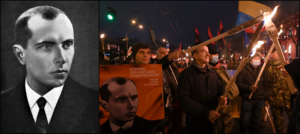
Zľava: Stepan Bandera (Wikimedia Commons). Vpravo: Pochod krajnej pravice na počesť Banderových 112. narodenín, Kyjev, 1. januára 2021 (Genya Savilov/AFP cez Getty Images).
Kyjev — V roku 2016 bol hlavný kyjevský bulvár premenovaný po Banderovi. Premenovanie je obzvlášť obscénne, pretože ulica vedie do Babiho Jaru , rokliny, kde nacisti s pomocou ukrajinských kolaborantov za dva dni vyhladili 33 771 Židov, čo bol jeden z najväčších samostatných masakrov holokaustu. Centrum Simona Wiesenthala aj Svetový židovský kongres tento krok odsúdili.
Vpravo hore, každoročný pochod s fakľami pri príležitosti Banderových narodenín v roku 2021; počas spomienkových osláv v roku 2017 účastníci pochodu skandovali „ Židia von! “.
spoločné pomníky jemu a Romanovi Šuchevičovi v Čerkasoch , Horishnie (Novorozdilʹska Miska Rada) , Počaiv , Rudky a Záviy ;

pamätník jemu, Šuchevičovi a ďalším vodcom OUN v Moršine ;
pamätník jemu a jeho otcovi v Pidpečery ;

pamätná tabuľa a pamätník v Lucku ;
basreliéf, pamätník a múzeum v Dublianoch ;

.jpg)
pamätná tabuľa , pamätník a múzeum (s bustou ) v Stryji ;
.jpg)

pamätná tabuľa , ulica a pamätník v Zdolbuniv;
pamiatky Berezhany , Boryslav , Buchach , Chervonohrad , Čortkov , Drohobych , Dubno , Hordynya , Horodenka , Hrabivka ( Ivano-Frankivsk Raion), Kalush , Kamianka -Buzka , Kolomyia , Kozivka , Kremenets , Kyiv a L. Krushelny plaketa ) , Mlyniv , Mostyska , Mykolaiv (Ľvovská oblasť), Mykytyntsi , Nyzhnye (Sambir Raion), Pidvolochysk , Romanivka , Sambir, Skole , Sniatyn , StaryiSambir , Seredniy Bereziv , Sokal , Sosnivka , Trusavvet Strusiv , Turkmeniste , Uzyn , Velyki Mosty , Verbiv (Narayiv Hromada), Zahirochka a Zališčiky ;


pamätná tabuľa a ulica v Sňatyne a Žytomyre ;
plakety v Ivano-Frankivsku , Chmelnyckom , Rivne a Rohatyne .
múzeá v Starom Uhrynive (so sochou a pamätnou tabuľou) a vo Volji-Zaderevatskej (s bustou a basreliéfom);
park v Kamianke-Buzkej ;
ulica v Dnipre a škola v Dobromyle.
(Poznámka: Vyznamenania Dnipro a Tatariv boli pridané v októbri 2022; pamätná tabuľa Rohatyn bola pridaná v júni 2025.)
Zľava: Stepan Bandera (Wikimedia Commons). Vpravo: Pochod krajnej pravice na počesť Banderových 112. narodenín, Kyjev, 1. januára 2021 (Genya Savilov/AFP cez Getty Images).
Kyjev — V roku 2016 bol hlavný kyjevský bulvár premenovaný po Banderovi. Premenovanie je obzvlášť obscénne, pretože ulica vedie do Babiho Jaru , rokliny, kde nacisti s pomocou ukrajinských kolaborantov za dva dni vyhladili 33 771 Židov, čo bol jeden z najväčších samostatných masakrov holokaustu. Centrum Simona Wiesenthala aj Svetový židovský kongres tento krok odsúdili.
Vpravo hore, každoročný pochod s fakľami pri príležitosti Banderových narodenín v roku 2021; počas spomienkových osláv v roku 2017 účastníci pochodu skandovali „ Židia von! “.
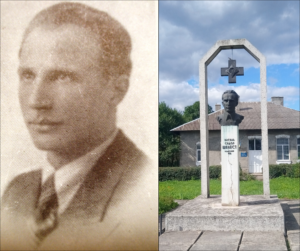
Vľavo: Pamätník Romana Šucheviča, Krakovec (Wikimedia Commons). Vpravo: basreliéf na Šuchevičovom rodnom dome, Ľvov (Wikimedia Commons). Obrázok od Forward collage
Krakovec, Ľvov a mnohé ďalšie mestá – Pamätníky Romana Šucheviča (1907 – 1950), ďalšej osobnosti OUN a nacistického kolaboranta, ktorý bol veliteľom pomocného práporu Nachtigall v nacistickom Nemecku, ktorý sa neskôr stal 201. pomocnou policajnou jednotkou Schutzmannschaft . Šuchevič neskôr velil brutálnej Ukrajinskej povstaleckej armáde (UPA), ktorá bola zodpovedná za masakrovanie tisícov Židov a 70 000 – 100 000 Poliakov.
Pamätník v Krakovci (vľavo hore) a pamätná tabuľa vo Ľvove (vpravo hore) sú dve z mnohých Šuchevičových sôch na Ukrajine. Patria sem spoločné pamätníky venované jemu a ďalším nacionalistom vo viacerých mestách (pozri vyššie uvedený záznam o Banderovi), pamätník venovaný jemu a ďalším nacionalistom v Spryni ; pamätník, dve pamätné tabule a basreliéf na Národnej polytechnickej univerzite v Ľvove ; a pamätníky v Borščive , Ivano-Frankivsku , Kaluši , Chmeľnickom , Chuste, Kňahyničoch (a pamätná tabuľa ), Koločave, Oglejive , Šmankivckom , Starom Uhrynive (v múzeu Stepana Banderu), Tyškivtsyahu , Tyudive a Zabolotivke ; pamätné tabule v Bučači , Kamianke-Buzkej, Kolomyji , Pukive , Radomyšli , Rivne a Volji-Zaderevatskej; múzeum v Hrimne; štadión v Ternopile; stanica metra v Kyjeve ; a škola v Ivano-Frankivsku. Pozrite si The Algemeiner o tom, ako Izrael kritizuje pomenovanie štadióna v Ternopile po Šuchevičovi.


Ešte šokujúcejšie sú Šuchevičove pamätníky v Kanade a USA
Okrem toho je Šuchevič poctený niekoľkými desiatkami ulíc na Ukrajine (je ich toľko, že v tomto projekte je uvedených len niekoľko). Väčšina sôch Banderu a Šucheviča sa nachádza na západnej Ukrajine, v mestách, kde bolo židovské obyvateľstvo vyhladené paramilitárnymi jednotkami lojálnymi týmto mužom. Po Šuchevičovi bol pomenovaný aj hlavný bulvár v Kyjeve. Svetový židovský kongres odsúdil oslavu Šucheviča a sochy v Ivano-Frankivsku.
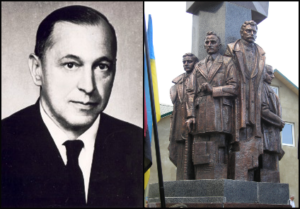
Zľava: Yaroslav Stetsko (Wikimedia Commons). Vpravo: Busta Stetsko, Ternopil (Wikimedia Commons). Obrázok podľa koláže vpred
Ternopil — Busta genocídneho Jaroslava Stetska (1912 – 1986), ktorý v roku 1941 viedol ukrajinskú kolaborantskú vládu s nacizmom, ktorá privítala Nemcov a vyhlásila vernosť Hitlerovi. Stetsko, zúrivý antisemita, napísal: „Trvám na vyhladení Židov a na potrebe prispôsobiť nemecké metódy vyhladzovania Židov na Ukrajine.“ Päť dní pred nacistickou inváziou Stetsko uistil vodcu OUN-B Stepana Banderu: „Zorganizujeme ukrajinskú milíciu, ktorá nám pomôže odstrániť Židov.“
Dodržal slovo – nemeckú inváziu na Ukrajinu sprevádzali hrozné pogromy s podnecovaním a horlivou účasťou nacionalistov OUN. Len prvý ľvovský pogrom si vyžiadal 4 000 obetí. Do konca vojny ukrajinské nacionalistické skupiny zmasakrovali desaťtisíce Židov, a to ako v spolupráci s nacistickými eskadrami smrti, tak aj z vlastnej vôle.
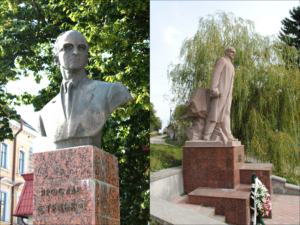
Ternopil — Busta genocídneho Jaroslava Stetska (1912 – 1986), ktorý v roku 1941 viedol ukrajinskú kolaborantskú vládu s nacizmom, ktorá privítala Nemcov a vyhlásila vernosť Hitlerovi. Stetsko, zúrivý antisemita, napísal: „Trvám na vyhladení Židov a na potrebe prispôsobiť nemecké metódy vyhladzovania Židov na Ukrajine.“ Päť dní pred nacistickou inváziou Stetsko uistil vodcu OUN-B Stepana Banderu: „Zorganizujeme ukrajinskú milíciu, ktorá nám pomôže odstrániť Židov.“
Dodržal slovo – nemeckú inváziu na Ukrajinu sprevádzali hrozné pogromy s podnecovaním a horlivou účasťou nacionalistov OUN. Len prvý ľvovský pogrom si vyžiadal 4 000 obetí. Do konca vojny ukrajinské nacionalistické skupiny zmasakrovali desaťtisíce Židov, a to ako v spolupráci s nacistickými eskadrami smrti, tak aj z vlastnej vôle.
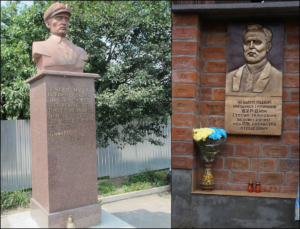
Zľava: Busta Jaroslava Stecka, Stryi (Wikimedia Commons). Vpravo: Socha Stetsko, Veľký Hlybochok (Wikimedia Commons). Obrázok podľa koláže vpred
Stryj a 18 ďalších miest – Ďalšie Stetskove pamätníky sa nachádzajú v Stryji (vľavo hore), kde sa nachádza aj Stetskova ulica, vo Veľkom Hlybočoku (vpravo hore), kde sa nachádza aj Stetskovo múzeum (s pamätnou tabuľou) a škola, v Kamjankách a Volji Zaderevatskej . Stetsko má tiež spoločný pamätník pre seba a ďalších vodcov OUN v Moršine a na uliciach v Buči, Dniprope, Dubne, Horodoku (Chmelnycká oblasť), Chmelnyckom, Lucku, Ľvove, Mežryčičii (Šeptycký rajón), Monastyryske, Pervomajsku (Mykolajevská oblasť), Rivne, Rudne, Sambire a Ternopile. Po vojne sa Stetsko – muž, ktorý formálne prisahal lojalitu svojej vlády Hitlerovi – presťahoval do USA, kde sa rýchlo dostal do najvyšších kruhov Washingtonu. Ronald Reagan a George H. W. Bush ho oslavovali ako vodcu bojovníkov za slobodu.
Vľavo dole, Stetsko sa stretáva s vtedajším viceprezidentom Bushom, 1983. Vpravo dole, Stetskov podpis na Vyhlásení ukrajinskej štátnosti so záväzkom „úzko spolupracovať s národno-socialistickým Veľkonemeckom pod vedením Adolfa Hitlera“.
(Poznámka: Ulice Bucha, Dnipro, Horodok (Chmelnická oblasť), Mezhryčičja (Šeptycký raj) a Pervomajsk (Mykolajovská oblasť) boli pridané v júni 2025.)
(Mykolajovská oblasť) boli pridané v júni 2025.)
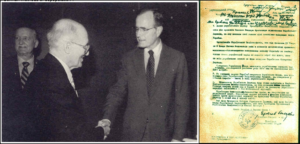
Stryj a 18 ďalších miest – Ďalšie Stetskove pamätníky sa nachádzajú v Stryji (vľavo hore), kde sa nachádza aj Stetskova ulica, vo Veľkom Hlybočoku (vpravo hore), kde sa nachádza aj Stetskovo múzeum (s pamätnou tabuľou) a škola, v Kamjankách a Volji Zaderevatskej . Stetsko má tiež spoločný pamätník pre seba a ďalších vodcov OUN v Moršine a na uliciach v Buči, Dniprope, Dubne, Horodoku (Chmelnycká oblasť), Chmelnyckom, Lucku, Ľvove, Mežryčičii (Šeptycký rajón), Monastyryske, Pervomajsku (Mykolajevská oblasť), Rivne, Rudne, Sambire a Ternopile. Po vojne sa Stetsko – muž, ktorý formálne prisahal lojalitu svojej vlády Hitlerovi – presťahoval do USA, kde sa rýchlo dostal do najvyšších kruhov Washingtonu. Ronald Reagan a George H. W. Bush ho oslavovali ako vodcu bojovníkov za slobodu.


Vľavo dole, Stetsko sa stretáva s vtedajším viceprezidentom Bushom, 1983. Vpravo dole, Stetskov podpis na Vyhlásení ukrajinskej štátnosti so záväzkom „úzko spolupracovať s národno-socialistickým Veľkonemeckom pod vedením Adolfa Hitlera“.
(Poznámka: Ulice Bucha, Dnipro, Horodok (Chmelnická oblasť), Mezhryčičja (Šeptycký raj) a Pervomajsk (Mykolajovská oblasť) boli pridané v júni 2025.)
(Mykolajovská oblasť) boli pridané v júni 2025.)
Vľavo: Jaroslav Stetsko, vľavo, s vtedajším viceprezidentom USA Georgeom H. W. Bushom, 1983. Vpravo: Stetskův podpis na vyhlásení z 30. júna 1941 o vytvorení nacistickej kolaborantskej vlády frakciou Stepana Banderu z Organizácie ukrajinských nacionalistov (OUN-B); vláde predsedal Stetsko (Wikimedia Commons). Obrázok od Forward collage
***
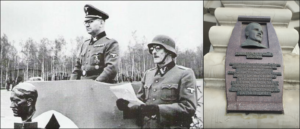
***
Vľavo: Dmytro Paliiv, Waffen-Hauptsturmführer 14. divízie granátnikov SS (1. haličská), vpravo, na slávnostnom ceremoniáli SS, 1943/1944. Vpravo: Paliivova pamätná tabuľa, Ľvov (Wikimedia Commons). Obrázok od Forward collage
Ľvov a dve ďalšie lokality — Pamätná tabuľa Dmytra Paliiva (1896–1944), spoluzakladateľa a Waffen-Hauptsturmführera 14. granátnickej divízie Waffen SS (1. galícijskej) známej ako SS Galičina, odhalená v roku 2007. SS Galičina bola sformovaná ako divízia v rámci Waffen-SS v roku 1943; medzi vojnové zločiny tejto formácie patrí masaker v Hute Pieniackej , keď podjednotka SS Galičina zmasakrovala 500 – 1 200 poľských dedinčanov vrátane upálenia ľudí zaživa.
Vľavo hore, Paliiv (držiaci papier) na slávnostnom obrade SS, 1943 – 1944. Tento dôstojník Waffen-SS má pamätnú tabuľu a basreliéf vo svojom rodisku Perevozetsa (odhalený v roku 2001), ako aj pamätnú tabuľua ulicu v Kaluši. JTA informovala o vyhrážkach smrťou mužovi, ktorý nesúhlasil s pomenovaním ulice.
Vľavo dole, pochod v Stanislavove (dnes Ivano-Frankivsk) na západnej Ukrajine, október 1941; vpravo dole, pochod oslavujúci 71. výročie založenia SS Galičina, Ľvov, západná Ukrajina, 2014. Pochod v Ľvove v roku 2018 pozostával zo stoviek ľudí, ktorí koordinovane vzdávali nacistické salvy . Pozri správu JTA .
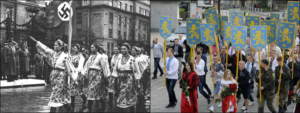
Ľvov a dve ďalšie lokality — Pamätná tabuľa Dmytra Paliiva (1896–1944), spoluzakladateľa a Waffen-Hauptsturmführera 14. granátnickej divízie Waffen SS (1. galícijskej) známej ako SS Galičina, odhalená v roku 2007. SS Galičina bola sformovaná ako divízia v rámci Waffen-SS v roku 1943; medzi vojnové zločiny tejto formácie patrí masaker v Hute Pieniackej , keď podjednotka SS Galičina zmasakrovala 500 – 1 200 poľských dedinčanov vrátane upálenia ľudí zaživa.
Vľavo hore, Paliiv (držiaci papier) na slávnostnom obrade SS, 1943 – 1944. Tento dôstojník Waffen-SS má pamätnú tabuľu a basreliéf vo svojom rodisku Perevozetsa (odhalený v roku 2001), ako aj pamätnú tabuľua ulicu v Kaluši. JTA informovala o vyhrážkach smrťou mužovi, ktorý nesúhlasil s pomenovaním ulice.
Vľavo dole, pochod v Stanislavove (dnes Ivano-Frankivsk) na západnej Ukrajine, október 1941; vpravo dole, pochod oslavujúci 71. výročie založenia SS Galičina, Ľvov, západná Ukrajina, 2014. Pochod v Ľvove v roku 2018 pozostával zo stoviek ľudí, ktorí koordinovane vzdávali nacistické salvy . Pozri správu JTA .
Vľavo: sprievod na počesť generálneho guvernéra Poľska Tretej ríše Hansa Franka, Stanislaviv (dnes Ivano-Frankivsk), október 1941 (Wikimedia Commons). Vpravo: pochod pripomínajúci založenie 14. granátnickej divízie SS (1. haličská), Ľvov, 28. apríla 2014 (Jurij Djačišyn/AFP cez Getty Images). Obrázok od Forward collage
Poznámka: Nižšie uvedené položky boli pridané počas aktualizácie projektu v januári/apríli 2022.
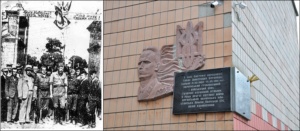
Poznámka: Nižšie uvedené položky boli pridané počas aktualizácie projektu v januári/apríli 2022.
Vľavo: Taras Bulba-Borovec (v strede) so štábom, 21. septembra 1941 (Wikimedia Commons). Transparent: „Sloboda Ukrajine! Smrť Moskve!“ naľavo od svastiky; „Nech žije nemecká armáda!“ napravo od svastiky. Vpravo: Pamätná tabuľa a basreliéf Bulbu-Borovca, Bystriči (Wikimedia Commons). Obrázok od Forward collage
Bystriči a sedem ďalších miest – Pamätná tabuľa Tarasovi Bulbovi-Borovcovi (1908 – 1973), kolaborantovi, ktorého nacisti vymenovali za veliteľa ukrajinskej milície v okrese Sarny. Bulbovi-Borovcovi muži organizovali a vykonávali početné pogromy, pri ktorých vraždili Židov v oblasti. Okrem tabule v rodnej dedine má Bulba-Borovec ďalšiu tabuľu v Olevsku , pamätník v Bereznom a na uliciach v Kyjeve, Lucku, Ovruči, Rokytne (Sarnyjský rajón) a Žytomyre.
Po vojne sa Bulba-Borovec, podobne ako mnohí nacistickí kolaboranti, usadil v Kanade, kde viedol noviny v ukrajinskom jazyku. Vľavo hore, Bulba-Borovec (v strede) so zamestnancami, 1941. Transparent napravo od vlajky so svastikou hovorí „Nech žije nemecká armáda!“. Viac informácií o oslave Bulbu-Borovca nájdete v článku historika Jareda McBridea, vo svedectve očitých svedkov holokaustu v Olevsku v Jahad-In Unum a vo svedectve pozostalých v Jad Vašem .
(Poznámka: Ulica Rokytné bola pridaná v auguste 2023; ulica Kyjev bola pridaná v júni 2025.)
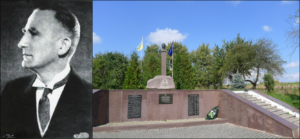
Bystriči a sedem ďalších miest – Pamätná tabuľa Tarasovi Bulbovi-Borovcovi (1908 – 1973), kolaborantovi, ktorého nacisti vymenovali za veliteľa ukrajinskej milície v okrese Sarny. Bulbovi-Borovcovi muži organizovali a vykonávali početné pogromy, pri ktorých vraždili Židov v oblasti. Okrem tabule v rodnej dedine má Bulba-Borovec ďalšiu tabuľu v Olevsku , pamätník v Bereznom a na uliciach v Kyjeve, Lucku, Ovruči, Rokytne (Sarnyjský rajón) a Žytomyre.

Po vojne sa Bulba-Borovec, podobne ako mnohí nacistickí kolaboranti, usadil v Kanade, kde viedol noviny v ukrajinskom jazyku. Vľavo hore, Bulba-Borovec (v strede) so zamestnancami, 1941. Transparent napravo od vlajky so svastikou hovorí „Nech žije nemecká armáda!“. Viac informácií o oslave Bulbu-Borovca nájdete v článku historika Jareda McBridea, vo svedectve očitých svedkov holokaustu v Olevsku v Jahad-In Unum a vo svedectve pozostalých v Jad Vašem .
(Poznámka: Ulica Rokytné bola pridaná v auguste 2023; ulica Kyjev bola pridaná v júni 2025.)
Zľava: Andriy Melnyk (Wikimedia Commons). Vpravo: Pamätný komplex Melnyk, Volya Yakubova (Wikimedia Commons). Obrázok podľa koláže vpred
Volja Jakubovová a 17 ďalších lokalít – Pamätný komplex a samostatné múzeum venované Andriyovi Melnykovi (1890 – 1964). V roku 1940 sa Organizácia ukrajinských nacionalistov (OUN) rozdelila na dve frakcie: OUN-M, vedenú Melnykom, a OUN-B, vedenú Stepanom Banderom. Melnykova frakcia bola rovnako genocídna ako Banderova – noviny OUN-M s radosťou oslavovali likvidáciu kyjevských Židov v Babom Jare (pozri nižšie uvedený záznam o Ivanovi Rohačovi).
OUN-M zostala spojencom nacistov, rovnako ako OUN-B. Nemecká invázia na Ukrajinu v roku 1941 bola privítaná transparentmi a proklamáciami ako „Sláva Hitlerovi! Sláva Melnykovi!“ (vľavo dole). Po vojne sa Melnyk presťahoval do Luxemburska a bol súčasťou ukrajinských diaspórnych organizácií.
Má tiež pamätník (vpravo dole) a ulicu v Ivano-Frankivsku, ako aj ulice v Bielej Cerkvi, Čerkasy, Čortkiv, Drohobyč, Dubno (Rivná oblasť), Kolomyja, Konotop, Korosteň, Kovel, Kyjev, Luck, Ľvov, Rivne, Stryzhivka, Sumy a Zhmery, Tatarbury. V roku 2020 Svetový židovský kongres a Židovská konfederácia Ukrajiny odsúdili pokus Kyjeva uctiť si Melnyka.
(Poznámka: Melnykova ulica v Kyjeve , ktorá bola pomenovaná napriek protestom Jad Vašem, bola pridaná v auguste 2023; ulice Bila Cerkva, Cherkasy, Konotop, Korosten, Kovel, Luck , Sumy, Tatarbunary a Zhmerynka boli pridané v júni 2025.)
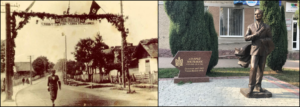
Volja Jakubovová a 17 ďalších lokalít – Pamätný komplex a samostatné múzeum venované Andriyovi Melnykovi (1890 – 1964). V roku 1940 sa Organizácia ukrajinských nacionalistov (OUN) rozdelila na dve frakcie: OUN-M, vedenú Melnykom, a OUN-B, vedenú Stepanom Banderom. Melnykova frakcia bola rovnako genocídna ako Banderova – noviny OUN-M s radosťou oslavovali likvidáciu kyjevských Židov v Babom Jare (pozri nižšie uvedený záznam o Ivanovi Rohačovi).
OUN-M zostala spojencom nacistov, rovnako ako OUN-B. Nemecká invázia na Ukrajinu v roku 1941 bola privítaná transparentmi a proklamáciami ako „Sláva Hitlerovi! Sláva Melnykovi!“ (vľavo dole). Po vojne sa Melnyk presťahoval do Luxemburska a bol súčasťou ukrajinských diaspórnych organizácií.
Má tiež pamätník (vpravo dole) a ulicu v Ivano-Frankivsku, ako aj ulice v Bielej Cerkvi, Čerkasy, Čortkiv, Drohobyč, Dubno (Rivná oblasť), Kolomyja, Konotop, Korosteň, Kovel, Kyjev, Luck, Ľvov, Rivne, Stryzhivka, Sumy a Zhmery, Tatarbury. V roku 2020 Svetový židovský kongres a Židovská konfederácia Ukrajiny odsúdili pokus Kyjeva uctiť si Melnyka.
(Poznámka: Melnykova ulica v Kyjeve , ktorá bola pomenovaná napriek protestom Jad Vašem, bola pridaná v auguste 2023; ulice Bila Cerkva, Cherkasy, Konotop, Korosten, Kovel, Luck , Sumy, Tatarbunary a Zhmerynka boli pridané v júni 2025.)
Vľavo: oblúk vítajúci nacistickú inváziu, 1941 (Eduard Dolinsky). Horný transparent: „Heil Hitler“. Dolný transparent: „Sláva Hitlerovi. Sláva Melnykovi“. Vpravo: Socha Andriya Melnyka, Ivano-Frankivsk (Google Maps). Obrázok od Forward collage
***
***
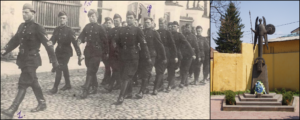
Vľavo: príslušníci pochodu 115. práporu Schutzmannschaft v Kyjeve, 1942 (Wikimedia Commons). Vpravo: Pamätník Bukovinský Kuren, Černovice (Wikimedia Commons). Obrázok podľa koláže vpred
Černovice – Pamätník Bukovinského kurenu, veľkej polovojenskej formácie zloženej z členov OUN-M (pozri vyššie uvedený záznam o Andriyovi Melnykovi). Jednotka bola pôvodne sformovaná v ukrajinsko-rumunskej oblasti Bukovina a po nacistickej invázii na Ukrajinu v roku 1941 zamierila do Kyjeva. Podľa viacerých správ jednotka vpochodovala do Kyjeva približne v čase masakru v Babom Jare , keď nacisti s pomocou ukrajinských nacionalistov zastrelili za dva dni 33 771 Židov v jednom z najhorších masakrov holokaustu.
Neskôr bola veľká časť Bukovinského kurenu reformovaná na 115. a 118. prápor Schutzmannschaft . Schutzmannschaft boli pomocné policajné prápory zložené z miestnych kolaborantov v Sovietskom zväze, predovšetkým na Ukrajine, v Bielorusku a Pobaltí. Boli podriadené Ordnungspolizei, ktorú kontrolovali SS. Tieto prápory zohrali kľúčovú úlohu vo vojne aj počas holokaustu: Nemecko ich použilo na potlačenie protinacistického odporu a na vykonanie genocídy zadržiavaním Židov v getách, ako aj ich masakrovaním na blízkych poliach a lesoch. Schutzmannschaft sa často dopúšťal vojnových zločinov proti Židom, iným etnikám, ako sú Rómovia, a civilistom z vlastnej vôle, nielen na nacistický rozkaz. (Viac informácií nájdete v práci Martina Deana .)
Dve čaty 118. práporu Schutzmannschaft sa vyznamenali spáchaním masakru v Chatyni v roku 1943 , keď zlikvidovali bieloruskú dedinu upálením obyvateľov zaživa a zastrelením každého, kto sa pokúsil o útek. (Pozri New York Times o jednom z páchateľov, ktorý emigroval do Kanady.)
Vľavo hore, vojaci 115. práporu Schutzmannschaft , ktorého súčasťou boli aj bojovníci Bukovinského kurenu, pochodujú Kyjevom v roku 1942. Pamätník Bukovinského kurenu nájdete v sekcii pre USA .
Vľavo hore, vojaci 115. práporu Schutzmannschaft , ktorého súčasťou boli aj bojovníci Bukovinského kurenu, pochodujú Kyjevom v roku 1942. Pamätník Bukovinského kurenu nájdete v sekcii pre USA .
Černovice – Pamätník Bukovinského kurenu, veľkej polovojenskej formácie zloženej z členov OUN-M (pozri vyššie uvedený záznam o Andriyovi Melnykovi). Jednotka bola pôvodne sformovaná v ukrajinsko-rumunskej oblasti Bukovina a po nacistickej invázii na Ukrajinu v roku 1941 zamierila do Kyjeva. Podľa viacerých správ jednotka vpochodovala do Kyjeva približne v čase masakru v Babom Jare , keď nacisti s pomocou ukrajinských nacionalistov zastrelili za dva dni 33 771 Židov v jednom z najhorších masakrov holokaustu.
Neskôr bola veľká časť Bukovinského kurenu reformovaná na 115. a 118. prápor Schutzmannschaft . Schutzmannschaft boli pomocné policajné prápory zložené z miestnych kolaborantov v Sovietskom zväze, predovšetkým na Ukrajine, v Bielorusku a Pobaltí. Boli podriadené Ordnungspolizei, ktorú kontrolovali SS. Tieto prápory zohrali kľúčovú úlohu vo vojne aj počas holokaustu: Nemecko ich použilo na potlačenie protinacistického odporu a na vykonanie genocídy zadržiavaním Židov v getách, ako aj ich masakrovaním na blízkych poliach a lesoch. Schutzmannschaft sa často dopúšťal vojnových zločinov proti Židom, iným etnikám, ako sú Rómovia, a civilistom z vlastnej vôle, nielen na nacistický rozkaz. (Viac informácií nájdete v práci Martina Deana .)
Dve čaty 118. práporu Schutzmannschaft sa vyznamenali spáchaním masakru v Chatyni v roku 1943 , keď zlikvidovali bieloruskú dedinu upálením obyvateľov zaživa a zastrelením každého, kto sa pokúsil o útek. (Pozri New York Times o jednom z páchateľov, ktorý emigroval do Kanady.)
Vľavo hore, vojaci 115. práporu Schutzmannschaft , ktorého súčasťou boli aj bojovníci Bukovinského kurenu, pochodujú Kyjevom v roku 1942. Pamätník Bukovinského kurenu nájdete v sekcii pre USA .
Vľavo hore, vojaci 115. práporu Schutzmannschaft , ktorého súčasťou boli aj bojovníci Bukovinského kurenu, pochodujú Kyjevom v roku 1942. Pamätník Bukovinského kurenu nájdete v sekcii pre USA .
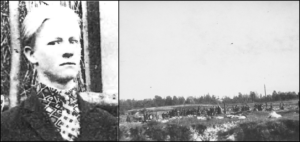
Zľava: Oleksa Babiy (Wikimedia Commons). Vpravo: Židia boli nútení vyzliecť sa pred zavraždením v Babi Yar, Kyjev, 29. – 30. septembra 1941 (United States Holocaust Memorial Museum, Ernst Klee Archive). Obrázok podľa koláže vpred
Žiznomir – V tejto dedine je pamätná tabuľa člena OUN-M Oleksu Babiya (1909 – 1944), ktorý sa priamo zúčastnil masakru v Babom Jare počas služby v jednotke Sonderkommando 4a Einsatzgruppe C, eskadry smrti SS, ktorá nesie hlavnú zodpovednosť za masaker. O dva roky neskôr sa Babiy stal dôstojníkom v SS Galičina, ukrajinskej divízii Waffen-SS (viac o SS Galičina nájdete nižšie v zázname Volodymyra Kubiyovyča). Vpravo hore sú Židia nútení vyzliecť sa a vzdať sa majetku pred zastrelením v Babom Jare. Svedectvá Jad Vašem nájdete tu .
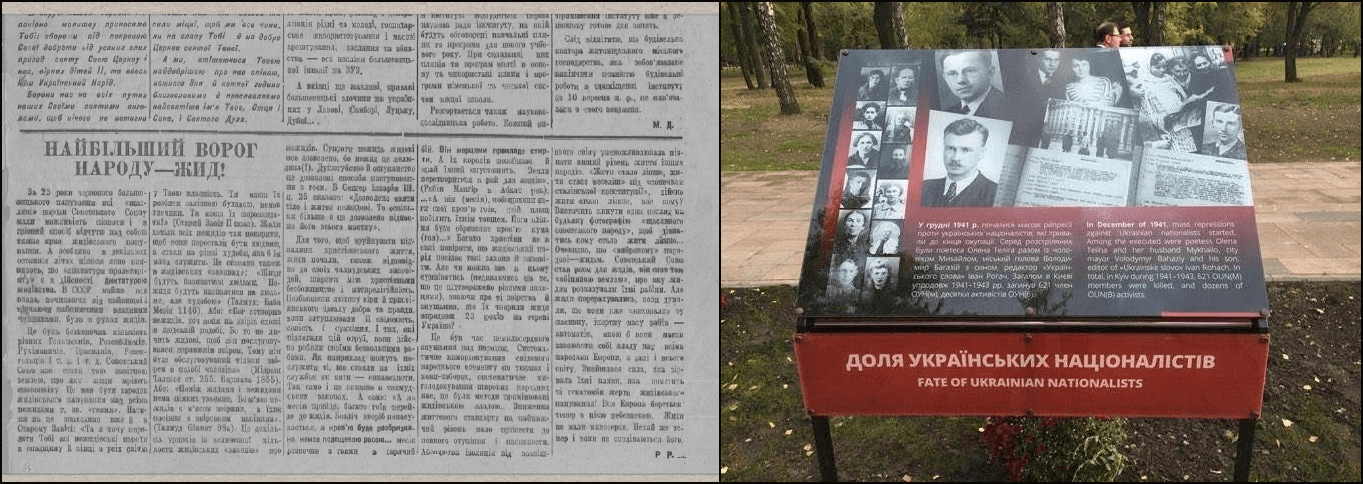 Vľavo: Úvodník Ukrajinskeho slova „Žid je najväčším nepriateľom nášho ľudu“, 2. októbra 1941 (Libraria.ua). Vpravo: dočasná výstava na počesť ukrajinských nacionalistov vrátane Ivana Rohača ako „obeti“ nacistov, ktorú postavila ukrajinská vláda pri príležitosti spomienky na Babí Jar, Kyjev, jeseň 2016 (Eduard Dolinský). Obrázok: Lev Golinkin
Kyjev a dve ďalšie lokality – Ulica pomenovaná po členovi OUN-M Ivanovi Rohačovi (1914 – 1942). Rohač, zarytý antisemita, vydával a redigoval Ukrajinské slovo, noviny OUN-M, ktoré hlasno obhajovali genocídu ukrajinských Židov. 2. októbra 1941, tri dni po tom, čo Nemci a ukrajinskí kolaboranti vyhladili 33 771 Židov v Babom Jare , Rohač uverejnil úvodník s názvom „Žid je najväčším nepriateľom ľudu“, v ktorom vyzval Ukrajincov, aby Židom neprejavovali žiadne zľutovanie (vľavo hore).
O týždeň neskôr uverejnil článok, v ktorom naliehal na čitateľov, aby hľadali všetkých židovských preživších, ktorí sa ukrývajú v meste. V tom istom týždni noviny Ukrajinské slovo oslavovali zlepšenie života v Kyjeve a chválili množstvo „neobývaných“ bytov, ktoré sa zrazu objavili. (Tieto byty boli židovské domy, ktoré sa stali „neobývanými“ v dôsledku masakru ich obyvateľov.)
Nemcov nakoniec unavili niektorí ich poskoci z OUN-M a Rohača popravili. V roku 2016 ukrajinská vláda urobila obscénne rozhodnutie smútiť nad ním ako nad obeťou nacistov počas spomienkových oslávmasakru v Babom Jare – masakru, ktorý tak nadšene podporoval (vpravo hore).
Rohač má ďalšiu ulicu v Chuste a pamätnú tabuľu a ulicu vo Velykyi Berezhny.
Žiznomir – V tejto dedine je pamätná tabuľa člena OUN-M Oleksu Babiya (1909 – 1944), ktorý sa priamo zúčastnil masakru v Babom Jare počas služby v jednotke Sonderkommando 4a Einsatzgruppe C, eskadry smrti SS, ktorá nesie hlavnú zodpovednosť za masaker. O dva roky neskôr sa Babiy stal dôstojníkom v SS Galičina, ukrajinskej divízii Waffen-SS (viac o SS Galičina nájdete nižšie v zázname Volodymyra Kubiyovyča). Vpravo hore sú Židia nútení vyzliecť sa a vzdať sa majetku pred zastrelením v Babom Jare. Svedectvá Jad Vašem nájdete tu .
Vľavo: Úvodník Ukrajinskeho slova „Žid je najväčším nepriateľom nášho ľudu“, 2. októbra 1941 (Libraria.ua). Vpravo: dočasná výstava na počesť ukrajinských nacionalistov vrátane Ivana Rohača ako „obeti“ nacistov, ktorú postavila ukrajinská vláda pri príležitosti spomienky na Babí Jar, Kyjev, jeseň 2016 (Eduard Dolinský). Obrázok: Lev GolinkinKyjev a dve ďalšie lokality – Ulica pomenovaná po členovi OUN-M Ivanovi Rohačovi (1914 – 1942). Rohač, zarytý antisemita, vydával a redigoval Ukrajinské slovo, noviny OUN-M, ktoré hlasno obhajovali genocídu ukrajinských Židov. 2. októbra 1941, tri dni po tom, čo Nemci a ukrajinskí kolaboranti vyhladili 33 771 Židov v Babom Jare , Rohač uverejnil úvodník s názvom „Žid je najväčším nepriateľom ľudu“, v ktorom vyzval Ukrajincov, aby Židom neprejavovali žiadne zľutovanie (vľavo hore).
O týždeň neskôr uverejnil článok, v ktorom naliehal na čitateľov, aby hľadali všetkých židovských preživších, ktorí sa ukrývajú v meste. V tom istom týždni noviny Ukrajinské slovo oslavovali zlepšenie života v Kyjeve a chválili množstvo „neobývaných“ bytov, ktoré sa zrazu objavili. (Tieto byty boli židovské domy, ktoré sa stali „neobývanými“ v dôsledku masakru ich obyvateľov.)
Nemcov nakoniec unavili niektorí ich poskoci z OUN-M a Rohača popravili. V roku 2016 ukrajinská vláda urobila obscénne rozhodnutie smútiť nad ním ako nad obeťou nacistov počas spomienkových oslávmasakru v Babom Jare – masakru, ktorý tak nadšene podporoval (vpravo hore).
Rohač má ďalšiu ulicu v Chuste a pamätnú tabuľu a ulicu vo Velykyi Berezhny.
Zľava: Oleh Olzhych (Wikimedia Commons). Vpravo: Pamätná tabuľa Olzhych, Kyjev (Wikimedia Commons). Obrázok podľa koláže vpred
Kyiv and 35 other locales – A plaque to Oleh Olzhych (1907–1944), archeologist, writer and prominent OUN-M member. Olzhych came to Kyiv part of an OUN-M formation designed to aid the nationalist takeover of Ukraine in 1941. He became a key figure in the Ukrayins’ka Natsional’na Rada. This OUN-M entity coordinated the formation of Ukrainian auxiliary police that aided the Germans. It also published propaganda such as the Ukrayins’ke Slovo (see Ivan Rohach entry above).
Olzhych’s honors include a library and street (with plaque) in Kyiv; a statue, library, street (with plaque) and another plaque in Zhytomyr; plaques and streets in Chernivtsi, Khust, L’viv, Rivne and Tyachiv; streets in Arbuzynka, Bilokorovychi, Ivano-Frankivsk, Korostyshiv, Kovel, Kremenchuk, Kremenets, Kropyvnytskyi, Letychiv, Lutsk, Nadvirna, Novyi Buh, Olevsk, Ostroh, Poltava, Rozsoshentsi, Sambir, Stryi, Sumy, Trubky, Verhnya Yablunka, Volodymyr-Volynskyi, Vyzhnytsya, Zalishchyky, Zdolbuniv, Zhuky and Zolochiv; a street and school in Mykolayiv; and a school in Pushcha-Vodytsia. See the U.S.section for an Olzhych bust.
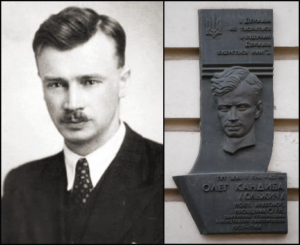
Kyiv and 35 other locales – A plaque to Oleh Olzhych (1907–1944), archeologist, writer and prominent OUN-M member. Olzhych came to Kyiv part of an OUN-M formation designed to aid the nationalist takeover of Ukraine in 1941. He became a key figure in the Ukrayins’ka Natsional’na Rada. This OUN-M entity coordinated the formation of Ukrainian auxiliary police that aided the Germans. It also published propaganda such as the Ukrayins’ke Slovo (see Ivan Rohach entry above).
Olzhych’s honors include a library and street (with plaque) in Kyiv; a statue, library, street (with plaque) and another plaque in Zhytomyr; plaques and streets in Chernivtsi, Khust, L’viv, Rivne and Tyachiv; streets in Arbuzynka, Bilokorovychi, Ivano-Frankivsk, Korostyshiv, Kovel, Kremenchuk, Kremenets, Kropyvnytskyi, Letychiv, Lutsk, Nadvirna, Novyi Buh, Olevsk, Ostroh, Poltava, Rozsoshentsi, Sambir, Stryi, Sumy, Trubky, Verhnya Yablunka, Volodymyr-Volynskyi, Vyzhnytsya, Zalishchyky, Zdolbuniv, Zhuky and Zolochiv; a street and school in Mykolayiv; and a school in Pushcha-Vodytsia. See the U.S.section for an Olzhych bust.

.jpg)


Left: Ivan Kedyulich (Wikimedia Commons). Right: members of the 115th Schutzmannschaft Battalion, Kyiv, 1942. Image by Forward collage
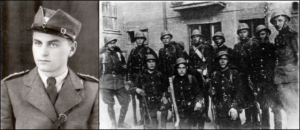
Perechyn – The town has a street jointly honoring brothers Ivan and Panas Kedyulich. Ivan Kedyulich (1912–1945) was an OUN-M member who came to Kyiv with the same formation as Oleg Olzhych (see entry above). Kedyulich became chief of the city’s local auxiliary police which aided the Nazis with massacres in Babi Yar and elsewhere. Police units organized by Kedyulich also provided fighters for the Schutzmannschaft battalions. Above right, fighters of the 115th Schutzmannschaft in Kyiv, 1942.
Perechyn – The town has a street jointly honoring brothers Ivan and Panas Kedyulich. Ivan Kedyulich (1912–1945) was an OUN-M member who came to Kyiv with the same formation as Oleg Olzhych (see entry above). Kedyulich became chief of the city’s local auxiliary police which aided the Nazis with massacres in Babi Yar and elsewhere. Police units organized by Kedyulich also provided fighters for the Schutzmannschaft battalions. Above right, fighters of the 115th Schutzmannschaft in Kyiv, 1942.
Left: Kost Himmel’raich (Wikimedia Commons). Right: Himmel’raich plaque, Ivanhorod (Eduard Dolinsky). Image by Forward collage
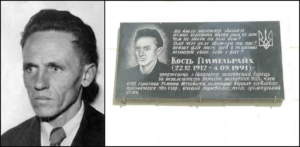
Ivanhorod – A plaque to Kost Himmel’raich (1912–1991), OUN-M member who worked with Ivan Kedyulich (see entry above) to form Kyiv’s German-controlled local auxiliary police. Himmel’raich’s plaque, like many plaques to Ukrainian collaborators, is located on a school where he’s presented as a role model for children.
Ivanhorod – A plaque to Kost Himmel’raich (1912–1991), OUN-M member who worked with Ivan Kedyulich (see entry above) to form Kyiv’s German-controlled local auxiliary police. Himmel’raich’s plaque, like many plaques to Ukrainian collaborators, is located on a school where he’s presented as a role model for children.
Left: Ivan Klymiv-Lehenda (Wikimedia Commons). Right: Klymiv-Lehenda statue, Silets’ (Wikimedia Commons). Image by Forward collage
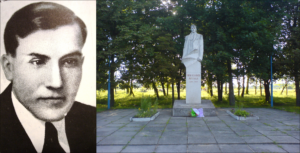
Silets’ (Chervonohrad Raion) and Sosnivka (Sokal Raion) – The June 1941 German invasion of Ukraine was accompanied by widespread pogroms resulting in the murder of thousands of Jews across western Ukraine. Many were organized and instigated by the OUN-B – the OUN’s Stepan Bandera branch (for more on the OUN split see Andriy Melnyk entry above). This included Ivan Klymiv (1909–1942) aka Klymiv-Lehenda, who was propagating leaflets urging the Ukrainian population to kill Jews.
While the invasion was happening, the OUN-B proclaimed its creation of a Ukrainian government led by Yaroslav Stetsko. This self-declared government formally pledged to work closely with Adolf Hitler (see Stetsko entry for more). Klymiv became minister of political coordination. In addition to the monument, he has a street and school in Silets’ and a joint monument to him and Bandera in Sosnivka (Sokal Raion).
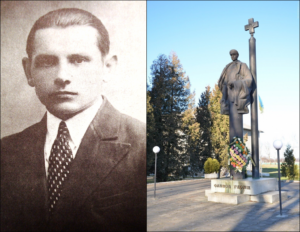
Silets’ (Chervonohrad Raion) and Sosnivka (Sokal Raion) – The June 1941 German invasion of Ukraine was accompanied by widespread pogroms resulting in the murder of thousands of Jews across western Ukraine. Many were organized and instigated by the OUN-B – the OUN’s Stepan Bandera branch (for more on the OUN split see Andriy Melnyk entry above). This included Ivan Klymiv (1909–1942) aka Klymiv-Lehenda, who was propagating leaflets urging the Ukrainian population to kill Jews.
While the invasion was happening, the OUN-B proclaimed its creation of a Ukrainian government led by Yaroslav Stetsko. This self-declared government formally pledged to work closely with Adolf Hitler (see Stetsko entry for more). Klymiv became minister of political coordination. In addition to the monument, he has a street and school in Silets’ and a joint monument to him and Bandera in Sosnivka (Sokal Raion).
Left: Oleksandr Hasyn (Wikimedia Commons). Right: Hasyn monument, Konyukhiv (Eduard Dolinsky). Image by Forward collage
Konyukhiv and five other locales – Konyukhiv has a monument, museum and street to village native Oleksandr Hasyn (1907–1949), deputy minister of defense in the 1941 self-declared OUN-B government. Afterward, Hasyn worked closely with fellow collaborator and UPA commander Roman Shukhevych when the UPA was conducting the ethnic cleansing of Poles (see Vasyl Vasylyashko entry below). Hasyn also has a plaque in Volya-Zaderevatska and streets in Molodynche, Sambir, Skole and Stryi.
(Note: The Molodynche street was added June 2025.)
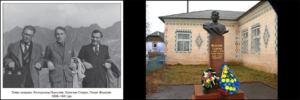
Konyukhiv and five other locales – Konyukhiv has a monument, museum and street to village native Oleksandr Hasyn (1907–1949), deputy minister of defense in the 1941 self-declared OUN-B government. Afterward, Hasyn worked closely with fellow collaborator and UPA commander Roman Shukhevych when the UPA was conducting the ethnic cleansing of Poles (see Vasyl Vasylyashko entry below). Hasyn also has a plaque in Volya-Zaderevatska and streets in Molodynche, Sambir, Skole and Stryi.
(Note: The Molodynche street was added June 2025.)
Left: Yaroslav-Mykhailo Starukh, middle (Wikimedia Commons). Right: Starukh bust, Zolota Slobova (Screenshot/YouTube). Image by Forward collage
Zolota Sloboda – A bust of Yaroslav-Mykhailo Starukh (1910–1947), secretary of the ministry of information and propaganda in the self-declared OUN-B government. The village also has a plaque of Starukh on a school building, where he’s promoted as an example to children.
Zolota Sloboda – A bust of Yaroslav-Mykhailo Starukh (1910–1947), secretary of the ministry of information and propaganda in the self-declared OUN-B government. The village also has a plaque of Starukh on a school building, where he’s promoted as an example to children.
Left: L’viv pogrom, July 1, 1941. Right: plaque commemorating the June 30, 1941 proclamation of the OUN-B collaborationist government, L’viv (Wikimedia Commons). Image by Forward collage
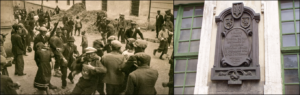
L’viv and Zmiivka – A plaque commemorating the proclamation of the self-declared OUN-B government in L’viv’s main square. This is particularly obscene given that as the proclamation was announced, the OUN-B was instigating and carrying out pogroms that made L’viv’s streets run with the blood of 6,000 Jews (above left). The Memorial to Fighters for Ukraine’s Freedom in Zmiivka also includes a commemorative plaque for the 1941 proclamation. See the U.S. section for another plaque commemorating the OUN-B proclamation.
L’viv and Zmiivka – A plaque commemorating the proclamation of the self-declared OUN-B government in L’viv’s main square. This is particularly obscene given that as the proclamation was announced, the OUN-B was instigating and carrying out pogroms that made L’viv’s streets run with the blood of 6,000 Jews (above left). The Memorial to Fighters for Ukraine’s Freedom in Zmiivka also includes a commemorative plaque for the 1941 proclamation. See the U.S. section for another plaque commemorating the OUN-B proclamation.
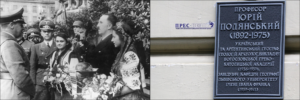
Left: L’viv mayor Yurii Polianskyi, second from right, welcomes Third Reich Governor-General of Poland Hans Frank (far left) to the city, L’viv, August 1, 1941 (National Digital Archives Poland). Right: Polianskyi plaque, L’viv (Kamenyar). Image by Forward collage
L’viv – Above left, L’viv’s mayor Yurii Polianskyi (1892–1975) welcomes Governor-General of Poland Hans Frank to the city, August 1, 1941. By this point, at least 6,000 of L’viv’s Jews were butchered in a series of pogroms incited and carried out in large part by Ukrainian nationalists.
Frank, aided by Ukrainian collaborators, went on to oversee the genocide of over 200,000 L’viv Jews; in 1946 he was hanged for crimes against humanity by the Nuremberg Tribunal. Polianskyi, on the other hand, emigrated to Argentina where he became a university professor. His memorial plaque in L’viv, above right, lists his academic achievements while omitting his WWII collaboration. See L’viv massacreand ghetto survivor testimonies, Yad Vashem.
L’viv – Above left, L’viv’s mayor Yurii Polianskyi (1892–1975) welcomes Governor-General of Poland Hans Frank to the city, August 1, 1941. By this point, at least 6,000 of L’viv’s Jews were butchered in a series of pogroms incited and carried out in large part by Ukrainian nationalists.
Frank, aided by Ukrainian collaborators, went on to oversee the genocide of over 200,000 L’viv Jews; in 1946 he was hanged for crimes against humanity by the Nuremberg Tribunal. Polianskyi, on the other hand, emigrated to Argentina where he became a university professor. His memorial plaque in L’viv, above right, lists his academic achievements while omitting his WWII collaboration. See L’viv massacreand ghetto survivor testimonies, Yad Vashem.
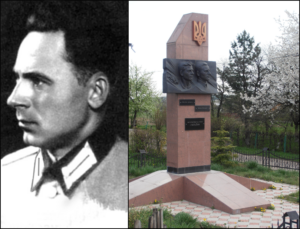
Left: Oleksandr Lutskyi (Wikimedia Commons). Right: All Fighters for Ukraine’s Freedom memorial with Lutskyi on right, Bodnariv (Wikimedia Commons). Image by Forward collage
Bodnariv and L’viv – Bodnariv’s monument to Oleksandr Lutskyi (1910–1946), an officer in Nazi Germany’s Nachtigall auxiliary battalion which invaded Ukraine alongside other Third Reich forces in June 1941. Nachtigall was a battalion in the Abwehr, the military intelligence division of the Third Reich’s armed forces. It was composed of Ukrainian volunteers, primarily from the OUN-B branch of the OUN. The Ukrainian commander was Roman Shukhevych who is glorified across Ukraine today (see his entry earlier).
In the fall of 1941, Nachtigall was reorganized into the 201st Schutzmannschaft auxiliary police battalion, which was involved in lethal antisemitic violence and brutal suppression of anti-Nazi resistance in Belarus. See the Bukovinsky Kuren entry for more on the Schutzmannschaft. Lutskyi also has a street in L’viv.
Bodnariv and L’viv – Bodnariv’s monument to Oleksandr Lutskyi (1910–1946), an officer in Nazi Germany’s Nachtigall auxiliary battalion which invaded Ukraine alongside other Third Reich forces in June 1941. Nachtigall was a battalion in the Abwehr, the military intelligence division of the Third Reich’s armed forces. It was composed of Ukrainian volunteers, primarily from the OUN-B branch of the OUN. The Ukrainian commander was Roman Shukhevych who is glorified across Ukraine today (see his entry earlier).
In the fall of 1941, Nachtigall was reorganized into the 201st Schutzmannschaft auxiliary police battalion, which was involved in lethal antisemitic violence and brutal suppression of anti-Nazi resistance in Belarus. See the Bukovinsky Kuren entry for more on the Schutzmannschaft. Lutskyi also has a street in L’viv.
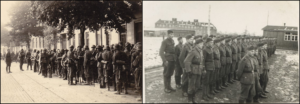
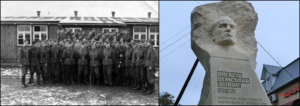
Left: Nachtigall Battalion in L’viv, June 30, 1941. Right: 201st Schutzmannschaft Battalion with Roman Shukhevych in the front row, closest to the camera, 1942. Image by Forward collage
Zavyshen’ – In 2018, this village unveiled a plaque to Vasyl Vasylyashko (1918–1946) who served in the Nachtigall Battalion, then in the 201st Schutzmannschaft Battalion. Afterward, Vasylyashko became a commander in the Ukrainian Insurgent Army (UPA), the OUN-B’s paramilitary wing created in 1943 and responsible for the ethnic cleansing of 70,000–100,000 Polish villages in the Volyn region.
There’s no clear historical photo of Vasylyashko; his plaque can be seen in a video of its unveiling ceremony. Above left, Nachtigall marching through L’viv on June 30, 1941, right as anti-Jewish pogroms raged throughout the city. Above right, the 201st Schutzmannschaft in training, 1942; Roman Shukhevych is in the front row, closest to the camera.
Zavyshen’ – In 2018, this village unveiled a plaque to Vasyl Vasylyashko (1918–1946) who served in the Nachtigall Battalion, then in the 201st Schutzmannschaft Battalion. Afterward, Vasylyashko became a commander in the Ukrainian Insurgent Army (UPA), the OUN-B’s paramilitary wing created in 1943 and responsible for the ethnic cleansing of 70,000–100,000 Polish villages in the Volyn region.
There’s no clear historical photo of Vasylyashko; his plaque can be seen in a video of its unveiling ceremony. Above left, Nachtigall marching through L’viv on June 30, 1941, right as anti-Jewish pogroms raged throughout the city. Above right, the 201st Schutzmannschaft in training, 1942; Roman Shukhevych is in the front row, closest to the camera.
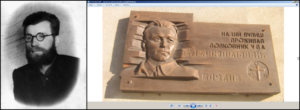
Left: Omelyan Polovyi (Wikimedia Commons). Right: Polovyi plaque, Ternopil (Screenshot/YouTube). Image by Forward collage
Ternopil – A plaque and street honoring Omelyan Polovyi (1913–1999). Polovyi followed the familiar path of OUN-B members, serving in Nachtigall, then commanding a platoon in the 201st SchutzmannschaftBattalion and later becoming a UPA colonel. Polovyi and other OUN-B fighters from Nachtigall, Schutzmannschaft and local auxiliary police battalions gained hands-on experience carrying out the Holocaust in 1941 and 1942. This murderous experience was put to use in 1943, when they joined the UPA and organized the ethnic cleansing of Poles.
Ternopil – A plaque and street honoring Omelyan Polovyi (1913–1999). Polovyi followed the familiar path of OUN-B members, serving in Nachtigall, then commanding a platoon in the 201st SchutzmannschaftBattalion and later becoming a UPA colonel. Polovyi and other OUN-B fighters from Nachtigall, Schutzmannschaft and local auxiliary police battalions gained hands-on experience carrying out the Holocaust in 1941 and 1942. This murderous experience was put to use in 1943, when they joined the UPA and organized the ethnic cleansing of Poles.
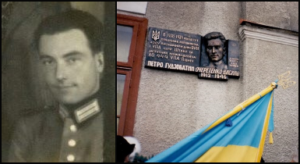
Left: Petro Hudzovatyi (Eduard Dolinsky). Right: Hudzovatyi plaque, Volodymyrtsi (Eduard Dolinsky). Image by Forward collage
Volodymyrtsi – A plaque to Petro Hudzovatyi (1912–1946), who fought in Nachtigall, then the 201st Schutzmannschaft Battalion then the UPA, where he commanded a district unit. The plaque is erected on a government building where Hudzovatyi once worked.
Volodymyrtsi – A plaque to Petro Hudzovatyi (1912–1946), who fought in Nachtigall, then the 201st Schutzmannschaft Battalion then the UPA, where he commanded a district unit. The plaque is erected on a government building where Hudzovatyi once worked.
Left: Vasyl Sydor (Wikimedia Commons). Right: Sydor bust, Spasiv (Wikimedia Commons). Image by Forward collage
Spasiv and Stryi – Spasiv’s bust of Vasyl Sydor (1910–1949), Nachtigall officer who became oberzugführer in the 201st Schutzmannschaft Battalion. Afterward, Sydor played a crucial role in the formation of the UPA, eventually becoming commander of UPA-West (one of the paramilitary’s four subdivisions). He also has a middle school in Spasiv and a street in Stryi. In 2020, the World Jewish Congress and the Jewish Confederation of Ukraine denounced Kyiv’s attempt to honor Sydor.
Spasiv and Stryi – Spasiv’s bust of Vasyl Sydor (1910–1949), Nachtigall officer who became oberzugführer in the 201st Schutzmannschaft Battalion. Afterward, Sydor played a crucial role in the formation of the UPA, eventually becoming commander of UPA-West (one of the paramilitary’s four subdivisions). He also has a middle school in Spasiv and a street in Stryi. In 2020, the World Jewish Congress and the Jewish Confederation of Ukraine denounced Kyiv’s attempt to honor Sydor.
Left: the 201st Schutzmannschaft Battalion training, Noihammer Germany, 1942; Roman Shukhevych is in the front row, second from left. Right: Oleksii Demskyi monument, Lypivka (Google Maps). Image by Forward collage
Lypivka (Rohatyn Raion) – A monument to Oleksii Demskyi (1922–1955), another member of Nachtigalland the 201st Schutzmannschaft Battalion. Above left, the 201st Schutmannschaft in training with Roman Shukhevych in the front row, second from left.
Lypivka (Rohatyn Raion) – A monument to Oleksii Demskyi (1922–1955), another member of Nachtigalland the 201st Schutzmannschaft Battalion. Above left, the 201st Schutmannschaft in training with Roman Shukhevych in the front row, second from left.
Left: Ivan Hrynokh (Wikimedia Commons). Right: monument to leaders of the Ukrainian Supreme Liberation Council, Sprynya (Wikimedia Commons). Image by Forward collage
Sprynya – This village’s joint monument to several OUN figures includes a statue of Ivan Hrynokh (1907–1994). Hrynokh, a priest in the Ukrainian Greek Catholic Church, served as chaplain in the Nachtigall Battalion, where he was awarded the Iron Cross, a Nazi Germany military honor. After his service to the Third Reich, Hrynokh became a publisher and professor in Munich. Hrynokh, like many OUN leaders, enjoyed a fruitful relationship with the CIA for decades after WWII: the agency’s analysis of him notes “he is very severe…he is capable of great cruelty.” See FOIA research and the CIA reading room for declassified documents.
Sprynya – This village’s joint monument to several OUN figures includes a statue of Ivan Hrynokh (1907–1994). Hrynokh, a priest in the Ukrainian Greek Catholic Church, served as chaplain in the Nachtigall Battalion, where he was awarded the Iron Cross, a Nazi Germany military honor. After his service to the Third Reich, Hrynokh became a publisher and professor in Munich. Hrynokh, like many OUN leaders, enjoyed a fruitful relationship with the CIA for decades after WWII: the agency’s analysis of him notes “he is very severe…he is capable of great cruelty.” See FOIA research and the CIA reading room for declassified documents.
Left: Dmytro Hakh bust, Khryplyn (Eduard Dolinsky). Right: Stepan Burdyn plaque, Khryplyn (Google Maps). Image by Forward collage
Khryplyn – This village celebrates two homegrown collaborators with a bust of Dmytro Hakh (1919–1945), above left, and a plaque to Stepan Burdyn (1912–1947), above right. Both served in Nachtigall(Hakh was an officer), then the 201st Schutzmannschaft Battalion. Afterward, both became UPA commanders.
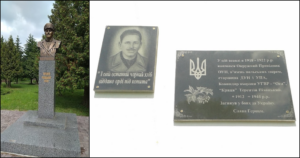
Khryplyn – This village celebrates two homegrown collaborators with a bust of Dmytro Hakh (1919–1945), above left, and a plaque to Stepan Burdyn (1912–1947), above right. Both served in Nachtigall(Hakh was an officer), then the 201st Schutzmannschaft Battalion. Afterward, both became UPA commanders.
Left: bust of Terentii Pikhotskyi as part of the Stepan Bandera monument, Sambir (Google Maps). Right: Pikhotskyi plaque, Storona. Image by Forward collage
Sambir and Storona – Sambir’s bust to Terentii Pikhotskyi (1912–1944) who fought in Nachtigall before becoming a UPA commander. He also has a plaque on a school in his home village of Storona.
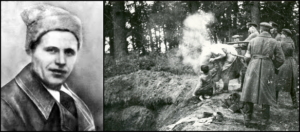
Sambir and Storona – Sambir’s bust to Terentii Pikhotskyi (1912–1944) who fought in Nachtigall before becoming a UPA commander. He also has a plaque on a school in his home village of Storona.
Left: Oleksiy Khymynets (Wikimedia Commons). Right: Ukrainian police executing a woman and two children, Miropol, October 13, 1941 (Security Services Archive, Historický fond StB (H), arch. č. H-770-3). Image by Forward collage
Sadzhava – This village honors native son Oleksiy Khymynets (1912–1945) with a monument and street. Khymynets served Germany not just in Nachtigall and the 201st Schutzmannschaft Battalion but also in local auxiliary police (see Volodymyr Schygel’skiy entry below for more on role of police). Afterward, he became a UPA officer. His street uses his nom de guerre “Blahyi”. Above right, a chilling rare photo of the Holocaust by bullets as it happened; Ukrainian police execute a woman and two children in Miropol, 1941.
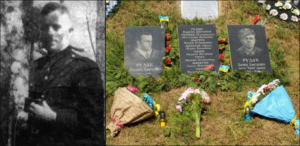
Sadzhava – This village honors native son Oleksiy Khymynets (1912–1945) with a monument and street. Khymynets served Germany not just in Nachtigall and the 201st Schutzmannschaft Battalion but also in local auxiliary police (see Volodymyr Schygel’skiy entry below for more on role of police). Afterward, he became a UPA officer. His street uses his nom de guerre “Blahyi”. Above right, a chilling rare photo of the Holocaust by bullets as it happened; Ukrainian police execute a woman and two children in Miropol, 1941.
Left: Danylo Rudak (Wikimedia Commons). Right: memorial with plaque to Rudak on the right, Nazavyziv. Image by Forward collage
Nazavyziv – A memorial plaque honoring Danylo Rudak (1917–1948), who served in Nachtigall and the 201st Schutzmannschaft Battalion, then became a UPA officer.
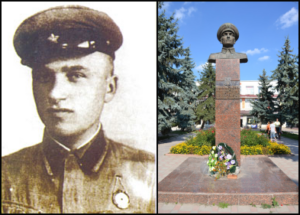
Nazavyziv – A memorial plaque honoring Danylo Rudak (1917–1948), who served in Nachtigall and the 201st Schutzmannschaft Battalion, then became a UPA officer.
Left: Petro Khamchuk (Wikimedia Commons). Right: Khamchuck bust, Chortkiv (Google Maps). Image by Forward collage
Chortkiv – A bust of Petro Khamchuk (1919–1947), another member of one of Nazi Germany’s Schutzmannschaft battalions. Afterwards, Khamchuck became a UPA commander.
Chortkiv – A bust of Petro Khamchuk (1919–1947), another member of one of Nazi Germany’s Schutzmannschaft battalions. Afterwards, Khamchuck became a UPA commander.
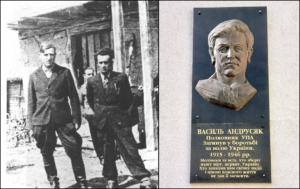
Left: Vasyl Andrusyak, left. Right: Andrusyak plaque, Cathedral of the Transformation, Ivano-Frankivsk (Google Maps). Image by Forward collage
Ivano-Frankivsk and three other locales – On the outside of the city’s Cathedral of the Transformation is a plaque to Vasyl Andrusyak (1915–1946). In 1941, Andrusyak was platoon commander in Nazi Germany’s Roland Battalion. Roland was a companion formation to the Nachtigall Battalion (see entries above): just like Nachtigall, it was a Ukrainian auxiliary unit in the Abwehr (Third Reich military intelligence) that participated in the Nazi invasion of Ukraine and was later reorganized into the 201st SchutzmannschaftBattalion.
After serving in Roland, Andrusyak became a UPA officer. He also has a statue, street and museum in his hometown of Sniatyn and streets in Hrabivka (Ivano-Frankivsk Oblast) and Kalush.
Ivano-Frankivsk and three other locales – On the outside of the city’s Cathedral of the Transformation is a plaque to Vasyl Andrusyak (1915–1946). In 1941, Andrusyak was platoon commander in Nazi Germany’s Roland Battalion. Roland was a companion formation to the Nachtigall Battalion (see entries above): just like Nachtigall, it was a Ukrainian auxiliary unit in the Abwehr (Third Reich military intelligence) that participated in the Nazi invasion of Ukraine and was later reorganized into the 201st SchutzmannschaftBattalion.
After serving in Roland, Andrusyak became a UPA officer. He also has a statue, street and museum in his hometown of Sniatyn and streets in Hrabivka (Ivano-Frankivsk Oblast) and Kalush.
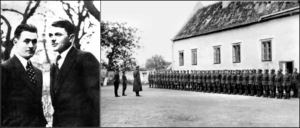
Left: Stepan Trokhymchuk, right. Right: Roland Battalion training in Seibergsdorf, Austria, 1941. Image by Forward collage
Tuchyn – This village honors native son Stepan Trokhymchuk (1909–1945) with a street. This is particularly perverse, considering that in 1942 Trokhymchuk was deputy chief of Tuchyn’s local auxiliary police which aided the Nazis in liquidating the Tuchyn ghetto and exterminating its 4,000-plus Jews. Before the war, Tuchyn’s population was majority Jewish; around 20 Jews survived the Holocaust enabled by Trokhymchuk (see survivor testimony here; survivor interviews by Yad Vashem; and eyewitness testimony by Yahad-In Unum). Prior to assisting the Nazis in Tuchyn, Trokhymchuk served them in the Roland Battalion. Above left, Trokhymchuk (on right); above right, Roland Battalion training in Seibergsdorf Austria, 1941.
Tuchyn – This village honors native son Stepan Trokhymchuk (1909–1945) with a street. This is particularly perverse, considering that in 1942 Trokhymchuk was deputy chief of Tuchyn’s local auxiliary police which aided the Nazis in liquidating the Tuchyn ghetto and exterminating its 4,000-plus Jews. Before the war, Tuchyn’s population was majority Jewish; around 20 Jews survived the Holocaust enabled by Trokhymchuk (see survivor testimony here; survivor interviews by Yad Vashem; and eyewitness testimony by Yahad-In Unum). Prior to assisting the Nazis in Tuchyn, Trokhymchuk served them in the Roland Battalion. Above left, Trokhymchuk (on right); above right, Roland Battalion training in Seibergsdorf Austria, 1941.
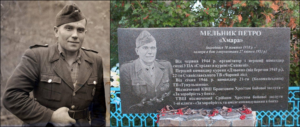
Left: Petro Melnyk. Right: Melnyk plaque, Kaminne (Eduard Dolinsky). Image by Forward collage
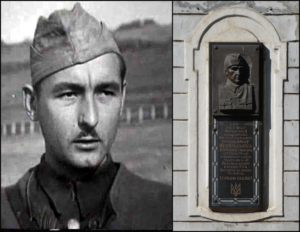
Kaminne – A memorial plaque to Petro Melnyk (1910–1953), who served in Roland, then the 201st Schutzmannschaft Battalion and then became a UPA commander. The plaque omits any mention of his service for the Nazis.
Kaminne – A memorial plaque to Petro Melnyk (1910–1953), who served in Roland, then the 201st Schutzmannschaft Battalion and then became a UPA commander. The plaque omits any mention of his service for the Nazis.
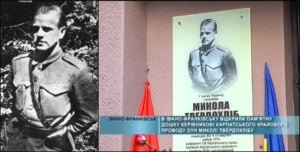
Left: Mykola Tverdohlib. Right: Tverdohlib plaque, part of the “Ivano-Frankivsk – A City of Heroes” program, Ivano-Frankivsk (Screenshot/YouTube). Image by Forward collage
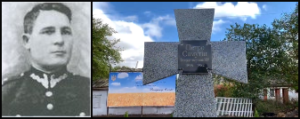
Ivano-Frankivsk and Petryliv – Ivano-Frankivsk features a plaque to Mykola Tverdohlib (1911–1954), who served in Roland prior to becoming a UPA commander. He also has a memorial in his birth village of Petryliv.
Ivano-Frankivsk and Petryliv – Ivano-Frankivsk features a plaque to Mykola Tverdohlib (1911–1954), who served in Roland prior to becoming a UPA commander. He also has a memorial in his birth village of Petryliv.
Left: Dmytro Myron (Wikimedia Commons). Right: Myron bust, Rai (Wikimedia Commons). Image by Forward collage
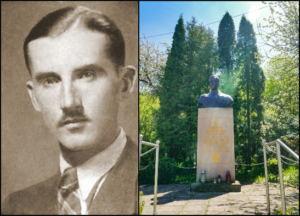
Rai – Dmytro Myron (1911–1942) aka Orlyk was one of the OUN’s main ideologues who authored the “44 Rules of the Life of a Ukrainian Nationalist,” a set of tenets considered foundational to the OUN.
Myron was the political educator of the Roland Battalion. His writings are filled with antisemitic imagery depicting Jews and other ethnicities as a “foreign element” syphoning resources and feeding off of Ukraine; he also portrayed Jews as agents of Communism (an old antisemitic trope propagated by Josef Goebbels, among others). His bust is in his home village of Rai.
Rai – Dmytro Myron (1911–1942) aka Orlyk was one of the OUN’s main ideologues who authored the “44 Rules of the Life of a Ukrainian Nationalist,” a set of tenets considered foundational to the OUN.
Myron was the political educator of the Roland Battalion. His writings are filled with antisemitic imagery depicting Jews and other ethnicities as a “foreign element” syphoning resources and feeding off of Ukraine; he also portrayed Jews as agents of Communism (an old antisemitic trope propagated by Josef Goebbels, among others). His bust is in his home village of Rai.
Left: Roman Sushko (Wikimedia Commons). Right: Bergbauernhilfe badge (Wikimedia Commons). Image by Forward collage
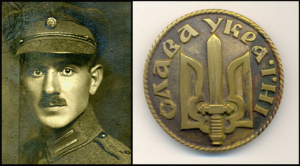
L’viv and Brovary – Both have streets named for Roman Sushko (1894–1944), OUN leader who commanded the Bergbauernhilfe aka the Ukrainian Military Units of Nationalists or the Sushko Legion. The Sushko Legion was another Ukrainian volunteer unit composed mostly of OUN members in Nazi Germany’s armed forces.
The Sushko Legion entered WWII earlier than the Nachtigall and Roland battalions (see entries above). Nachtigall and Roland were used by the Nazis in the 1941 invasion of the Soviet Union; the Sushko Legion was designed to aid the Third Reich’s 1939 invasion of Poland. Above right, the legion’s badge.
L’viv and Brovary – Both have streets named for Roman Sushko (1894–1944), OUN leader who commanded the Bergbauernhilfe aka the Ukrainian Military Units of Nationalists or the Sushko Legion. The Sushko Legion was another Ukrainian volunteer unit composed mostly of OUN members in Nazi Germany’s armed forces.
The Sushko Legion entered WWII earlier than the Nachtigall and Roland battalions (see entries above). Nachtigall and Roland were used by the Nazis in the 1941 invasion of the Soviet Union; the Sushko Legion was designed to aid the Third Reich’s 1939 invasion of Poland. Above right, the legion’s badge.
Left: Volodymyr Schygel’skiy (Wikimedia Commons). Right: Schygel’skiy plaque, L’viv (Wikimedia Commons). Image by Forward collage
L’viv – One of the fighters in the Sushko Legion (see entry above) was Volodymyr Schygel’skiy (1921–1949). Afterward, Schygel’skiy served in several Nazi-controlled local auxiliary police units that actively partook in the Holocaust in western Ukraine. He later became a UPA officer. The plaque describing this war criminal as a “legendary commander” is on a building where he attended school.
Unlike the Schutzmannschaft battalions (see entries above), which were deployed by the Third Reich to various locations, local auxiliary police units such as those Schygel’skiy served in were based in specific cities, towns and villages throughout Ukraine. These local collaborators were invaluable to the Nazis: they spoke the local languages, knew the people and were intimately familiar with the terrain, including where Jews or anti-Nazi resistance fighters could hide.
Auxiliary police participated in the Holocaust by rounding up Jews, hunting down escapees, imprisoning Jews in ghettos, forcibly relocating them to be exterminated in death camps or simply massacring them on the spot, on the outskirts of towns or in pits dug in local forests. The security and guard duties performed by local auxiliary police freed up SS Einsatzgruppen death squads and Schutzmannschaftbattalions, which were then deployed to perpetuate the Holocaust in other regions.
During the rare cases Nazi collaborators have been deported from the U.S., Washington treated service in the local auxiliary police as equivalent to serving the Nazis. For a graphic eyewitness account of the crucial role of local auxiliary police in the Holocaust in Ukraine, see testimony of Hermann Friedrich Gräbe from the Nuremberg trials and survivor testimony from Yad Vashem. Also see historian Wendy Lower’s haunting book “The Ravine”.
L’viv – One of the fighters in the Sushko Legion (see entry above) was Volodymyr Schygel’skiy (1921–1949). Afterward, Schygel’skiy served in several Nazi-controlled local auxiliary police units that actively partook in the Holocaust in western Ukraine. He later became a UPA officer. The plaque describing this war criminal as a “legendary commander” is on a building where he attended school.
Unlike the Schutzmannschaft battalions (see entries above), which were deployed by the Third Reich to various locations, local auxiliary police units such as those Schygel’skiy served in were based in specific cities, towns and villages throughout Ukraine. These local collaborators were invaluable to the Nazis: they spoke the local languages, knew the people and were intimately familiar with the terrain, including where Jews or anti-Nazi resistance fighters could hide.
Auxiliary police participated in the Holocaust by rounding up Jews, hunting down escapees, imprisoning Jews in ghettos, forcibly relocating them to be exterminated in death camps or simply massacring them on the spot, on the outskirts of towns or in pits dug in local forests. The security and guard duties performed by local auxiliary police freed up SS Einsatzgruppen death squads and Schutzmannschaftbattalions, which were then deployed to perpetuate the Holocaust in other regions.
During the rare cases Nazi collaborators have been deported from the U.S., Washington treated service in the local auxiliary police as equivalent to serving the Nazis. For a graphic eyewitness account of the crucial role of local auxiliary police in the Holocaust in Ukraine, see testimony of Hermann Friedrich Gräbe from the Nuremberg trials and survivor testimony from Yad Vashem. Also see historian Wendy Lower’s haunting book “The Ravine”.
Left: Petro Samutin (Wikimedia Commons). Right: Samutin plaque on the Fighters for Ukrainian Freedom memorial, Tashan’ (Screenshot/YouTube). Image by Forward collage
Tashan’ – This memorial to “Fighters for Ukrainian Freedom” features a plaque to Petro Samutin (1896–1982), an officer in the Abwehr, the Third Reich’s military intelligence division. After the war, Samutin relocated to the U.S.
Tashan’ – This memorial to “Fighters for Ukrainian Freedom” features a plaque to Petro Samutin (1896–1982), an officer in the Abwehr, the Third Reich’s military intelligence division. After the war, Samutin relocated to the U.S.
Left: Yurii Horlis-Horskyi (Wikimedia Commons). Right: Horlis-Horskyi memorial, Melnyky (Wikimedia Commons). Image by Forward collage
Melnyky (Cherkasy Raion, Medvedivka Hromada) and 12 other locales – A monument to Yurii Horlis-Horskyi (1898 – disappeared 1946). A hero of Ukraine’s WWI-era independence struggles as well as a writer, Horlis-Horskyi spent WWII working as an agent of the Abwehr, helping the Nazis uncover resistance efforts in Ukraine. Horlis-Horskyi mysteriously vanished in 1946. He has another monument in Rozumivka (Kirovohrad Oblast) and streets in Dnipro, Holovkivka (Cherkasy Oblast), Kam’yanka, Kremenchuk, Kropyvnytskyi, L’viv, Poltava, Reshetylivka, Rivne, Smila and Zvenyhorodka.
(Note: The Dnipro, Holovkivka (Cherkasy Oblast), Kam’yanka, Kremenchuk, Kropyvnytskyi, Reshetylivka and Smila streets were added June 2025.)
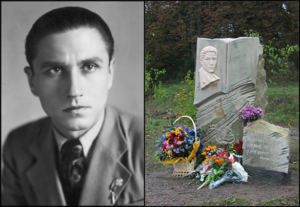
Melnyky (Cherkasy Raion, Medvedivka Hromada) and 12 other locales – A monument to Yurii Horlis-Horskyi (1898 – disappeared 1946). A hero of Ukraine’s WWI-era independence struggles as well as a writer, Horlis-Horskyi spent WWII working as an agent of the Abwehr, helping the Nazis uncover resistance efforts in Ukraine. Horlis-Horskyi mysteriously vanished in 1946. He has another monument in Rozumivka (Kirovohrad Oblast) and streets in Dnipro, Holovkivka (Cherkasy Oblast), Kam’yanka, Kremenchuk, Kropyvnytskyi, L’viv, Poltava, Reshetylivka, Rivne, Smila and Zvenyhorodka.
(Note: The Dnipro, Holovkivka (Cherkasy Oblast), Kam’yanka, Kremenchuk, Kropyvnytskyi, Reshetylivka and Smila streets were added June 2025.)
Left: Omelyan Hrabets, left (Eduard Dolinsky). Right: Hrabets plaque, Lityn (Eduard Dolinsky). Image by Forward collage
Lityn (Vinnytsia Oblast) and two other locales – Lityn’s memorial plaque and street for Omelyan Hrabets (1911–1944) celebrate another OUN member who served in the Nazi-controlled local auxiliary police. Hrabets’ service was in Rivne (then called Rovno), where the Germans, together with local police units, murdered over 20,000 Jews by deporting them from the city’s ghetto to death camps or shooting them on site (see here for survivor testimony; eyewitness testimony by Yahad-In Unum). Above left, Hrabets in uniform, on left; note the police armbands. Hrabets then became a colonel in charge of the UPA-South division. He also has streets in Ladyzhyn and Vinnytsia.
(Note: The Ladyzhyn street was added March 2024.)
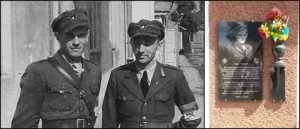
Lityn (Vinnytsia Oblast) and two other locales – Lityn’s memorial plaque and street for Omelyan Hrabets (1911–1944) celebrate another OUN member who served in the Nazi-controlled local auxiliary police. Hrabets’ service was in Rivne (then called Rovno), where the Germans, together with local police units, murdered over 20,000 Jews by deporting them from the city’s ghetto to death camps or shooting them on site (see here for survivor testimony; eyewitness testimony by Yahad-In Unum). Above left, Hrabets in uniform, on left; note the police armbands. Hrabets then became a colonel in charge of the UPA-South division. He also has streets in Ladyzhyn and Vinnytsia.
(Note: The Ladyzhyn street was added March 2024.)
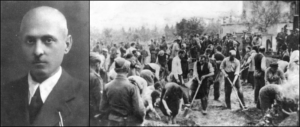
Left: Leonid Stupnytskyi (Wikimedia Commons). Right: Jews forced to dig their own graves prior to being murdered, Storow, July 4, 1941 (Bundesarchiv, Bild 183-A0706-0018-029 via Wikimedia Commons). Image by Forward collage
Zhytomyr and two other locales – A street named for Leonid Stupnytskyi (1891–1944) who led the OUN-B’s 1st Ukrainian Regiment “Holodny Yar,” an auxiliary police training battalion in Rivne in 1941. Shortly afterward, his unit was reformed into a police training regiment under control of the German army. See Omelyan Hrabets entry above for more on the Holocaust in Rivne. Stupnytskyi also has streets in Rudnya and Ostroh. Above right, Jews in Storow forced to dig their own graves before being massacred, July 1941. Such haunting scenes were commonplace in WWII Ukraine.
Zhytomyr and two other locales – A street named for Leonid Stupnytskyi (1891–1944) who led the OUN-B’s 1st Ukrainian Regiment “Holodny Yar,” an auxiliary police training battalion in Rivne in 1941. Shortly afterward, his unit was reformed into a police training regiment under control of the German army. See Omelyan Hrabets entry above for more on the Holocaust in Rivne. Stupnytskyi also has streets in Rudnya and Ostroh. Above right, Jews in Storow forced to dig their own graves before being massacred, July 1941. Such haunting scenes were commonplace in WWII Ukraine.
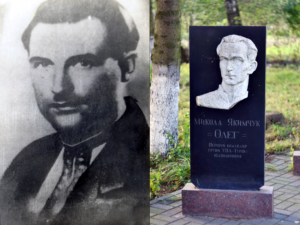
Left: Mykola Yakymchuk (Wikimedia Commons). Right: Yakymchuk memorial, Alley of Glory, Piddubtsi (Wikimedia Commons). Image by Forward collage
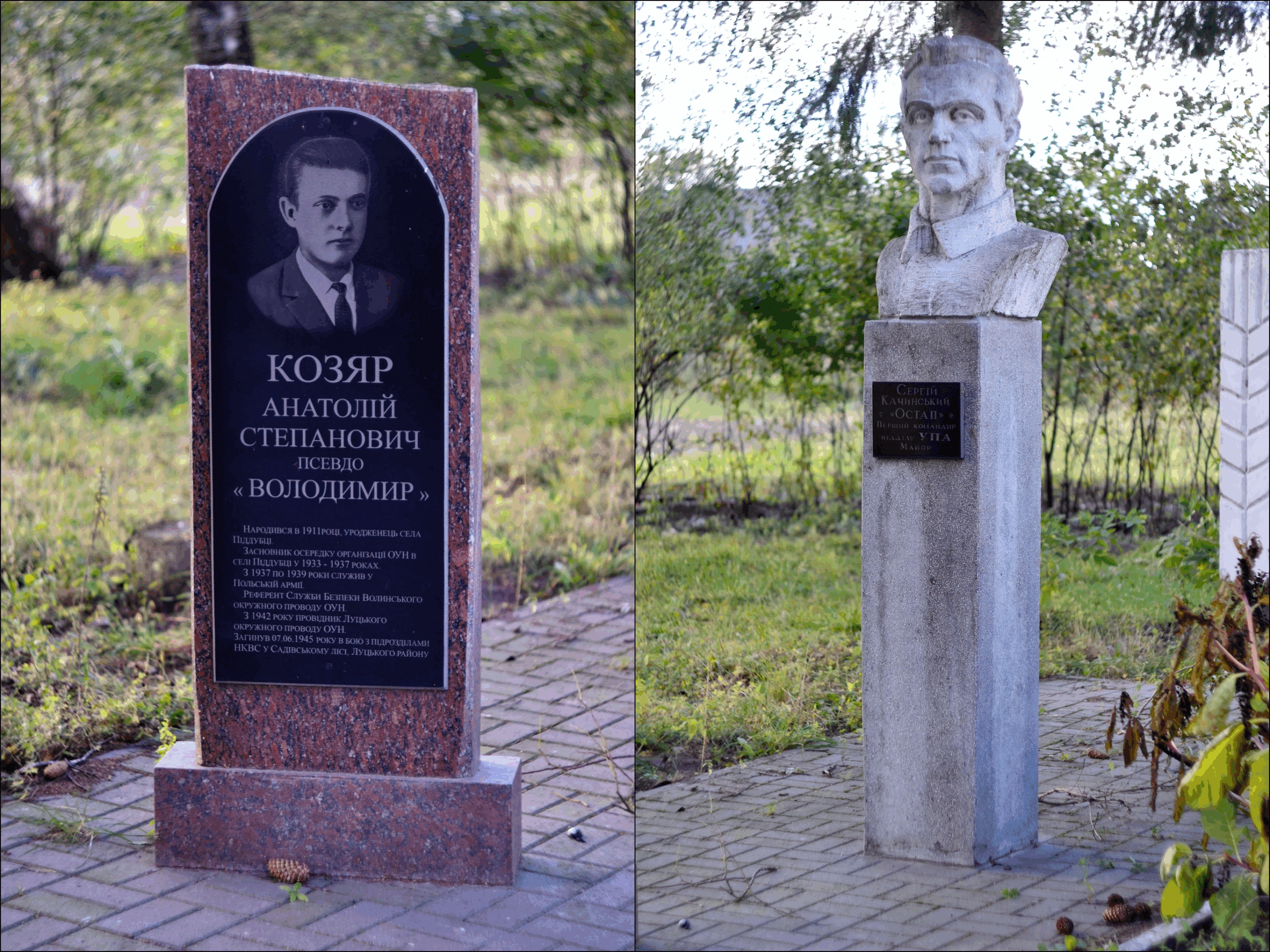
Piddubtsi (Volyn oblast) and Lutsk – The village’s Alley of Glory contains monuments to Serhii Kachinskyi (1917–1943), below right, and Mykola Yakymchuk (1914–1947), above right. Kachinskyi was commander of the Holodny Yar battalion (see entry above). Yakymchuck is another OUN member intimately involved in mass murders of both Jews and Poles. He served the Nazis as head of local auxiliary police of the city of Lutsk, which hunted down Jews. Later, Yakymchuk became a UPA commander in Volyn which perpetrated the ethnic cleansing of Poles. The Alley of Glory also contains a monument to native-born OUN commander Anatoliy Koziar (1913 – 1945), below left; Koziar also has a street in Lutsk. See testimony of a survivor of Lutsk Ghetto liquidation, in which Ukrainian police played a key role (in Hebrew with English subtitles).
(Note: Koziar’s monument and street were added March 2024.)
Piddubtsi (Volyn oblast) and Lutsk – The village’s Alley of Glory contains monuments to Serhii Kachinskyi (1917–1943), below right, and Mykola Yakymchuk (1914–1947), above right. Kachinskyi was commander of the Holodny Yar battalion (see entry above). Yakymchuck is another OUN member intimately involved in mass murders of both Jews and Poles. He served the Nazis as head of local auxiliary police of the city of Lutsk, which hunted down Jews. Later, Yakymchuk became a UPA commander in Volyn which perpetrated the ethnic cleansing of Poles. The Alley of Glory also contains a monument to native-born OUN commander Anatoliy Koziar (1913 – 1945), below left; Koziar also has a street in Lutsk. See testimony of a survivor of Lutsk Ghetto liquidation, in which Ukrainian police played a key role (in Hebrew with English subtitles).

(Note: Koziar’s monument and street were added March 2024.)
Left: Anatoliy Koziar monument, Alley of Glory, Piddubtsi (Wikimedia Commons). Right: Serhii Kachinskyi monument, Alley of Glory, Piddbutsi (Wikimedia Commons). Image by
***
***
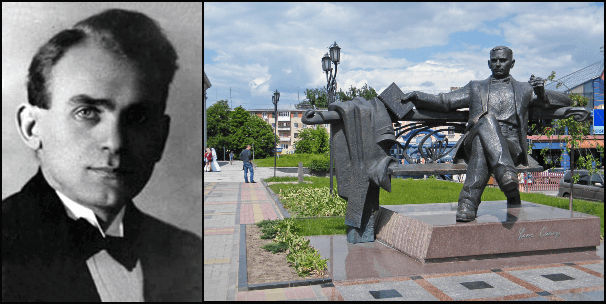
Left: Ulas Samchuk (Wikimedia Commons). Right: Samchuk monument, Rivne (Wikimedia Commons). Image by Lev Golinkin
Rivne and 24 other locales – Rivne has a statue (above right), museum, street and memorial plaque to Ulas Samchuk (1905–1987). The virulently antisemitic writer and OUN member published Rivne’s Volyn newspaper which ran hundreds of articles fomenting antisemitism. The paper’s fawning front page lead section, titled From the Führer’s Headquarters, covered Hitler’s decisions and ran excepts from his speeches. “Today is a great day for Kyiv,” Volyn wrote on the eve of the Babi Yar massacre. “The German authorities met the passionate desires of Ukrainians, ordering all Jews, of which there are still 150,000 remaining, to leave Kyiv.”
After the war, Samchuk settled in Canada where he founded a Ukrainian writers association. Samchuk’s whitewashers extol him as a writer while saying nothing about his antisemitism and Nazi propaganda. This tactic is used with other collaborationist authors like Hungary’s Albert Wass and Jòzsef Nyírő (see the Hungary and Romania sections).
Samchuk has a statue, museum and memorial plaque in Tyliavka; a museum and memorial plaque in Derman’; a plaque in Horodok; a bust and street in Zdolbuniv; and streets in Bila Tserkva, Dubno, Kalush, Kaniv, Kostopil, Kovel, Kremenets, Kyiv, Lukiv, Lutsk, L’viv, Lyuboml’, Novovolynsk, Ostroh, Rokytne (Sarny Raion), Stepan’, Ternopil, Volodymyr-Volynskyi, Zbarazh (Ternopil Raion) and Zhytomyr. In 2020, the World Jewish Congress and the Jewish Confederation of Ukraine denounced Kyiv’s attempt to honor Samchuk.
(Note: The Derman’ museum and Kyiv and Rokytne streets were added August 2023; the Kaniv street was added March 2024.)
Rivne and 24 other locales – Rivne has a statue (above right), museum, street and memorial plaque to Ulas Samchuk (1905–1987). The virulently antisemitic writer and OUN member published Rivne’s Volyn newspaper which ran hundreds of articles fomenting antisemitism. The paper’s fawning front page lead section, titled From the Führer’s Headquarters, covered Hitler’s decisions and ran excepts from his speeches. “Today is a great day for Kyiv,” Volyn wrote on the eve of the Babi Yar massacre. “The German authorities met the passionate desires of Ukrainians, ordering all Jews, of which there are still 150,000 remaining, to leave Kyiv.”

After the war, Samchuk settled in Canada where he founded a Ukrainian writers association. Samchuk’s whitewashers extol him as a writer while saying nothing about his antisemitism and Nazi propaganda. This tactic is used with other collaborationist authors like Hungary’s Albert Wass and Jòzsef Nyírő (see the Hungary and Romania sections).
Samchuk has a statue, museum and memorial plaque in Tyliavka; a museum and memorial plaque in Derman’; a plaque in Horodok; a bust and street in Zdolbuniv; and streets in Bila Tserkva, Dubno, Kalush, Kaniv, Kostopil, Kovel, Kremenets, Kyiv, Lukiv, Lutsk, L’viv, Lyuboml’, Novovolynsk, Ostroh, Rokytne (Sarny Raion), Stepan’, Ternopil, Volodymyr-Volynskyi, Zbarazh (Ternopil Raion) and Zhytomyr. In 2020, the World Jewish Congress and the Jewish Confederation of Ukraine denounced Kyiv’s attempt to honor Samchuk.


(Note: The Derman’ museum and Kyiv and Rokytne streets were added August 2023; the Kaniv street was added March 2024.)
Left: Stepan Skrypnyk (Patriarch Mstyslav), 1948 (Wikimedia Commons). Right: Mstyslav plaque on Saint Andrew’s Church, Kyiv (Wikimedia Commons). Image by Forward collage
Kyiv and 10 other locales – A memorial plaque to Stepan Skrypnyk (1898–1993) who became Patriarch Mstyslav, head of the Ukrainian Orthodox Church. In 1941–1942, around the time Skrypnyk was ordained into the priesthood, he was the publisher and manager of the extraordinarily antisemitic paper Volyn (see Ulas Samchuk entry above).
On March 29, 1942 Skrypnyk wrote a paean to the “Great European named Adolf Hitler,” who was “sent by providence” to liberate Europe and the world from Jews and Bolsheviks. Skrypnyk waxed poetic about Ukraine’s deliverance from “Moscow-Jewish Asiatic bondage,” eagerly anticipating the day “the fanfares of the German army will carry the song of victory across the globe.”
Skrypnyk’s Volyn incited genocidal hatred as the Holocaust raged across Ukraine. On November 6, 1941, Germans and Ukrainian collaborators exterminated about 21,000 Jews in Rivne. Three days later, Volyn – a Rivne-based paper – celebrated by running antisemitic cartoons with a caption: “For the Judeo-Bolshevik hydra, it’s the final hour.”
Ukraine’s honors to Skrypnyk include another plaque and a street in Kyiv; a plaque and street in Ternopil; a museum (with plaque) and street in Poltava; two plaques in Ivano-Frankivsk, two in L’viv, one in Kosivand another in Zalishchyky; and streets in Borsuky, Kamyanets-Podilskyi, Pidvolochysk and Verkhovyna.
Below, the masthead from Volyn’s inaugural edition, September 1, 1941. It lists Skrypnyk as publisher and manager, Ulas Samchuk as editor and the printing press’ address as 81 Adolf Hitler Street. See the U.S.section for an honorary street designation for Skrypnyk.
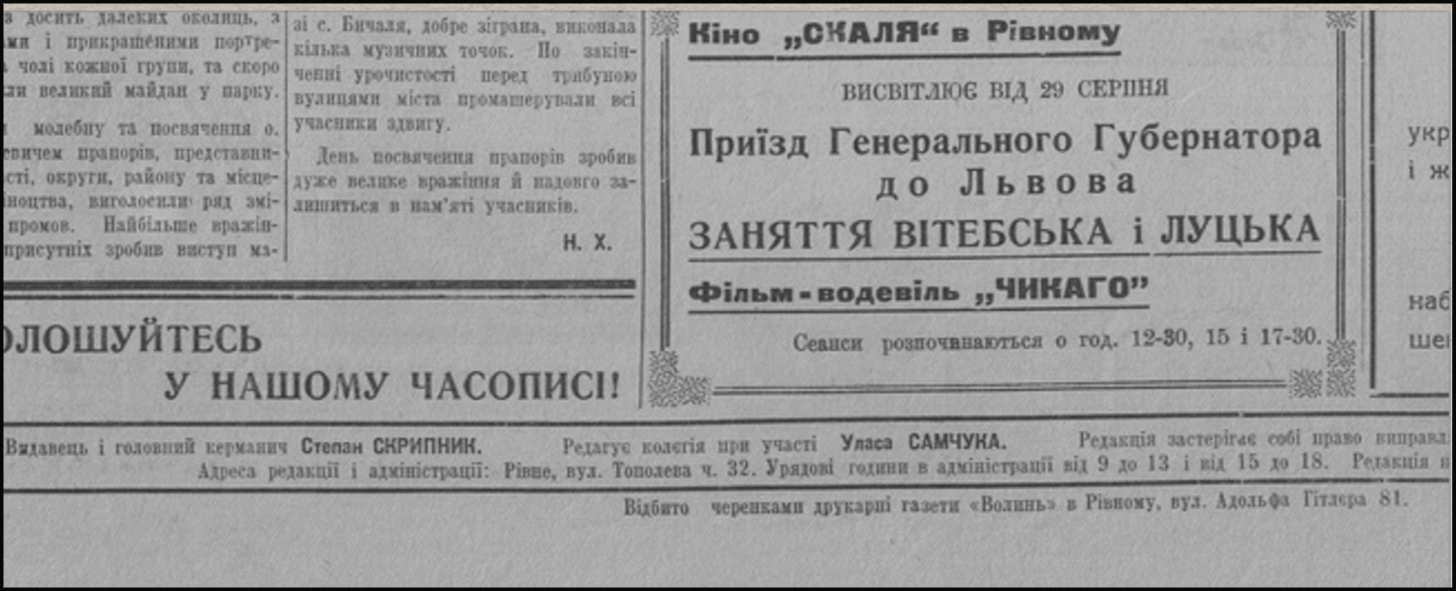 Masthead from the inaugural edition of Volyn, September 1, 1941 (Libraria.ua). Image by Lev Golinkin
***
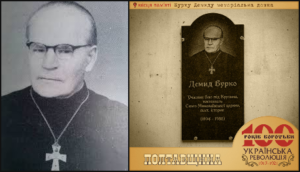
Kyiv and 10 other locales – A memorial plaque to Stepan Skrypnyk (1898–1993) who became Patriarch Mstyslav, head of the Ukrainian Orthodox Church. In 1941–1942, around the time Skrypnyk was ordained into the priesthood, he was the publisher and manager of the extraordinarily antisemitic paper Volyn (see Ulas Samchuk entry above).
On March 29, 1942 Skrypnyk wrote a paean to the “Great European named Adolf Hitler,” who was “sent by providence” to liberate Europe and the world from Jews and Bolsheviks. Skrypnyk waxed poetic about Ukraine’s deliverance from “Moscow-Jewish Asiatic bondage,” eagerly anticipating the day “the fanfares of the German army will carry the song of victory across the globe.”
Skrypnyk’s Volyn incited genocidal hatred as the Holocaust raged across Ukraine. On November 6, 1941, Germans and Ukrainian collaborators exterminated about 21,000 Jews in Rivne. Three days later, Volyn – a Rivne-based paper – celebrated by running antisemitic cartoons with a caption: “For the Judeo-Bolshevik hydra, it’s the final hour.”
Ukraine’s honors to Skrypnyk include another plaque and a street in Kyiv; a plaque and street in Ternopil; a museum (with plaque) and street in Poltava; two plaques in Ivano-Frankivsk, two in L’viv, one in Kosivand another in Zalishchyky; and streets in Borsuky, Kamyanets-Podilskyi, Pidvolochysk and Verkhovyna.

_%25D1%2582%25D0%25B0_%25D0%259F%25D0%25B0%25D1%2582%25D1%2580%25D1%2596%25D0%25B0%25D1%2580%25D1%2585%25D1%2583_%25D0%2592%25D0%25BE%25D0%25BB%25D0%25BE%25D0%25B4%25D0%25B8%25D0%25BC%25D0%25B8%25D1%2580%25D1%2583_(%25D0%25A0%25D0%25BE%25D0%25BC%25D0%25B0%25D0%25BD%25D1%258E%25D0%25BA%25D1%2583),_%25D0%25A6%25D0%25B5%25D1%2580%25D0%25BA%25D0%25B2%25D0%25B0_%25D0%25A0%25D1%2596%25D0%25B7%25D0%25B4%25D0%25B2%25D0%25B0_%25D0%25A5%25D1%2580%25D0%25B8%25D1%2581%25D1%2582%25D0%25BE%25D0%25B2%25D0%25BE%25D0%25B3%25D0%25BE,_%25D0%25A2%25D0%25B5%25D1%2580%25D0%25BD%25D0%25BE%25D0%25BF%25D1%2596%25D0%25BB%25D1%258C.jpg)
.jpg)


Below, the masthead from Volyn’s inaugural edition, September 1, 1941. It lists Skrypnyk as publisher and manager, Ulas Samchuk as editor and the printing press’ address as 81 Adolf Hitler Street. See the U.S.section for an honorary street designation for Skrypnyk.
Masthead from the inaugural edition of Volyn, September 1, 1941 (Libraria.ua). Image by Lev Golinkin***
Left: Demid Burko (Wikimedia Commons). Right: Burko plaque on Saint Nicholas Church, Poltava (Wikimedia Commons). Image by Forward collage
Poltava – A plaque commemorating Demid Burko (1894–1988), clergyman and writer who published screeds about the “battle of civilized nations against global Judeo-Bolshevism,” and claimed Stalin starved Ukraine “to build a Jewish kingdom.” The vile lie of Jews being responsible for Ukraine’s 1932–1933 famine was – and continues to be – used as “justification” for Ukrainians butchering Jews during the Holocaust.
Burko, just like Stepan Skrypnyk (see above), encouraged Ukrainians to join Hitler’s crusade against “Judeo-Bolshevism”. His exhortations were published in Poltava’s Holos Poltavshyny paper while the Holocaust unfolded; 5,000 of the city’s Jews were murdered. After successfully helping instigate the Holocaust in Poltava, Burko escaped to Germany, where he spent decades playing a leadership role in the Ukrainian Orthodox Church while publishing his works.
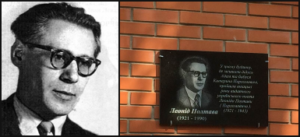
Poltava – A plaque commemorating Demid Burko (1894–1988), clergyman and writer who published screeds about the “battle of civilized nations against global Judeo-Bolshevism,” and claimed Stalin starved Ukraine “to build a Jewish kingdom.” The vile lie of Jews being responsible for Ukraine’s 1932–1933 famine was – and continues to be – used as “justification” for Ukrainians butchering Jews during the Holocaust.
Burko, just like Stepan Skrypnyk (see above), encouraged Ukrainians to join Hitler’s crusade against “Judeo-Bolshevism”. His exhortations were published in Poltava’s Holos Poltavshyny paper while the Holocaust unfolded; 5,000 of the city’s Jews were murdered. After successfully helping instigate the Holocaust in Poltava, Burko escaped to Germany, where he spent decades playing a leadership role in the Ukrainian Orthodox Church while publishing his works.
Left: Leonid Parhomovych aka Leonid Poltava, Wikimedia Commons. Right: Poltava plaque, Romny (Eduard Dolinsky). Image by Forward collage
Romny and Poltava – Both places have streets named for Leonid Parhomovych (1921–1990) aka Poltava. An antisemitic poet, Poltava celebrated the destruction of Romny’s Jews and churned out tracts like his ode to Hitler’s 53rd birthday. “The day rings out, the boundless sky is blue/It’s no coincidence that on this day, was born the Great Führer,” warbled Poltava, evoking images of Hitler as a deity of spring and rebirth.
While Poltava was publishing this, Romny’s Jews were being liquidated with the participation of Ukrainian police. After the war, Poltava ended up in the West working for the U.S.-government’s Radio Free Europe and Voice of America. He also has a plaque in Romny, above right.
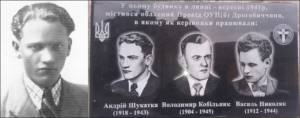
Romny and Poltava – Both places have streets named for Leonid Parhomovych (1921–1990) aka Poltava. An antisemitic poet, Poltava celebrated the destruction of Romny’s Jews and churned out tracts like his ode to Hitler’s 53rd birthday. “The day rings out, the boundless sky is blue/It’s no coincidence that on this day, was born the Great Führer,” warbled Poltava, evoking images of Hitler as a deity of spring and rebirth.
While Poltava was publishing this, Romny’s Jews were being liquidated with the participation of Ukrainian police. After the war, Poltava ended up in the West working for the U.S.-government’s Radio Free Europe and Voice of America. He also has a plaque in Romny, above right.
Left: Andriy Shukatka (Wikimedia Commons). Right: plaque to Shukatka, left, Volodymyr Kobilnyk, center, and Vasyl Nykolyak, right, on the library of the Drohobych State Pedagogical University Ivan Franko, Drohobych (Eduard Dolinsky). Image by Forward collage
Drohobych and Biynychi – A plaque to OUN members Andriy Shukatka (1918–1943), Volodymyr Kobilnyk (1904–1945) and Vasyl Nykolyak (1912–1944) on the library of Drohobych State Pedagogical University; in 1941, the building housed the city’s OUN headquarters. The Holocaust in Drohobych happened the same way as in other towns and villages in Ukraine: OUN members helped form a local auxiliary police which worked under the Nazis to imprison the city’s Jews in a ghetto. Afterward, the majority of Drohobych’s Jews were exterminated by being deported to the Belzec death camp or gunned down in the streets and nearby forest.
Shukatka (above left), Kobilnyk and Nykoyak were OUN leaders in Drohobych while the genocide was unfolding. Nykolyak, who went on to become a UPA officer, also has a street and memorial plaque in his home village of Biynychi. See Yahad-In Unum survivor interview here.
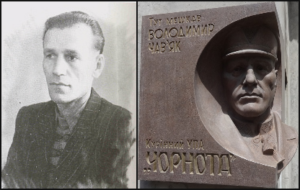
Drohobych and Biynychi – A plaque to OUN members Andriy Shukatka (1918–1943), Volodymyr Kobilnyk (1904–1945) and Vasyl Nykolyak (1912–1944) on the library of Drohobych State Pedagogical University; in 1941, the building housed the city’s OUN headquarters. The Holocaust in Drohobych happened the same way as in other towns and villages in Ukraine: OUN members helped form a local auxiliary police which worked under the Nazis to imprison the city’s Jews in a ghetto. Afterward, the majority of Drohobych’s Jews were exterminated by being deported to the Belzec death camp or gunned down in the streets and nearby forest.
Shukatka (above left), Kobilnyk and Nykoyak were OUN leaders in Drohobych while the genocide was unfolding. Nykolyak, who went on to become a UPA officer, also has a street and memorial plaque in his home village of Biynychi. See Yahad-In Unum survivor interview here.
Left: Volodymyr Chav’yak (Wikimedia Commons). Right: Chav’yak bas-relief, Halych (Wikimedia Commons). Image by Forward collage
Halych and Ivano-Frankivsk – The town of Halych features a bas-relief of Volodymyr Chav’yak (1922–1991), an officer in the local auxiliary police that aided Germany in annihilating thousands of Jews in Stanislaviv (now Ivano-Frankivsk). Local police were deployed to hunt Jews down, march victims to mass murder sites, execute them and guard Stanislaviv’s ghetto. See accounts in the U.S. Holocaust Memorial Museum, Yad Vashem (survivor documentary; more testimony) and Yahad-In Unum.
Afterward, Chav’yak went on to command a UPA battalion. Perversely, he also has a street and plaque in Ivano-Frankivsk, the city whose Jews he helped eradicate.
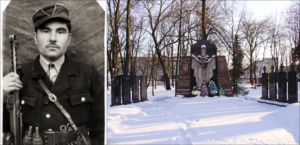
Halych and Ivano-Frankivsk – The town of Halych features a bas-relief of Volodymyr Chav’yak (1922–1991), an officer in the local auxiliary police that aided Germany in annihilating thousands of Jews in Stanislaviv (now Ivano-Frankivsk). Local police were deployed to hunt Jews down, march victims to mass murder sites, execute them and guard Stanislaviv’s ghetto. See accounts in the U.S. Holocaust Memorial Museum, Yad Vashem (survivor documentary; more testimony) and Yahad-In Unum.
Afterward, Chav’yak went on to command a UPA battalion. Perversely, he also has a street and plaque in Ivano-Frankivsk, the city whose Jews he helped eradicate.
Left: Serhii Bohdan. Right: Fighters for Ukraine’s Freedom memorial with Bohdan memorial stone on the far left, Lyuboml’ (Wikimedia Commons). Image by Forward collage
Lyuboml’ – The monument to freedom fighters includes a memorial plaque for Serhii Bohdan (1921–1950) who commanded the local auxiliary police. The Jews of Lyuboml’ were wiped out; out of 4,500, only 51 survived. The shooting was done by Einsatzgruppen working together with Lyuboml’s’ police. See coverage in the New York Times, Yad Vashem (survivor testimony) and a Lyuboml’ memorial book.
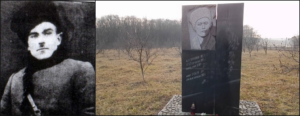
Lyuboml’ – The monument to freedom fighters includes a memorial plaque for Serhii Bohdan (1921–1950) who commanded the local auxiliary police. The Jews of Lyuboml’ were wiped out; out of 4,500, only 51 survived. The shooting was done by Einsatzgruppen working together with Lyuboml’s’ police. See coverage in the New York Times, Yad Vashem (survivor testimony) and a Lyuboml’ memorial book.
Left: Kostiantyn Peter (Wikimedia Commons). Right: Peter monument, Hrabovets (Eduard Dolinsky). Image by Forward collage
Hrabovets (Ivano-Frankivsk Oblast) – A monument at the house of Kostiantyn Peter (1893–1953) who served Nazi Germany as chief of the local auxiliary police of Bohoradchany and then in Tysmenytsia. During his service, the local auxiliary police helped annihilate the Jewish population. Peter then became a reconnaissance chief in the UPA. See Yahad-In Unum eyewitness testimony here.
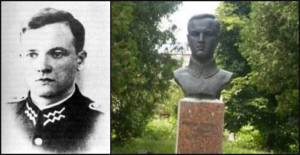
Hrabovets (Ivano-Frankivsk Oblast) – A monument at the house of Kostiantyn Peter (1893–1953) who served Nazi Germany as chief of the local auxiliary police of Bohoradchany and then in Tysmenytsia. During his service, the local auxiliary police helped annihilate the Jewish population. Peter then became a reconnaissance chief in the UPA. See Yahad-In Unum eyewitness testimony here.
Left: Martin Mizernyi (Wikimedia Commons). Right: Mizernyi bust, Verbiv (Eduard Dolinsky). Image by Forward collage
Verbiv (Pidhaitsi Hromada) – A monument to Martin Mizernyi (1910–1949), regional commander of local auxiliary police in the town of Sanok in Nazi-occupied Poland. Sanok’s ghetto eventually grew to imprison 10,000–13,000 Jews who were deported to extermination camps. Mizernyi later joined the UPA, where he served as district commander. Below, Mizernyi’s Third Reich police identification allowing him to carry a handgun and baton and granting him police power.
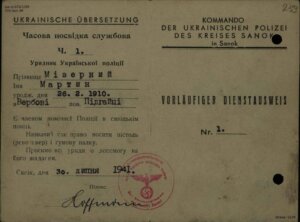
Verbiv (Pidhaitsi Hromada) – A monument to Martin Mizernyi (1910–1949), regional commander of local auxiliary police in the town of Sanok in Nazi-occupied Poland. Sanok’s ghetto eventually grew to imprison 10,000–13,000 Jews who were deported to extermination camps. Mizernyi later joined the UPA, where he served as district commander. Below, Mizernyi’s Third Reich police identification allowing him to carry a handgun and baton and granting him police power.
Martin Mizernyi’s auxiliary police identification papers issued by Nazi Germany (Eduard Dolinsky). Image by Forward collage
***
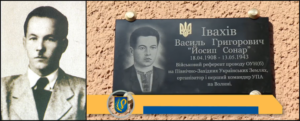
***
Left: Vasyl Ivakhiv (Wikimedia Commons). Right: Ivakhiv plaque, Rohatyn (Screenshot/YouTube). Image by Forward collage
Rohatyn and two other towns – A plaque to Vasyl Ivakhiv (1908–1943), commander of local auxiliary police in Peremyshliany; the police burned down the town’s synagogue including the Jews inside. Afterward, Ivakhiv became a UPA commander in Volyn, where it committed ethnic cleansing of Poles. He also has a monument and plaque in Podusil’na and a street in Bukovyna. See testimony of a survivor of Peremyshliany Ghetto, Yad Vashem.
(Note: The Bukovyna street was added June 2025.)
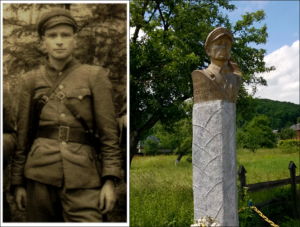
Rohatyn and two other towns – A plaque to Vasyl Ivakhiv (1908–1943), commander of local auxiliary police in Peremyshliany; the police burned down the town’s synagogue including the Jews inside. Afterward, Ivakhiv became a UPA commander in Volyn, where it committed ethnic cleansing of Poles. He also has a monument and plaque in Podusil’na and a street in Bukovyna. See testimony of a survivor of Peremyshliany Ghetto, Yad Vashem.
(Note: The Bukovyna street was added June 2025.)
Left: Yurii Dolishnyak (Wikimedia Commons). Right: Dolishnyak bust, Yabluniv (Wikimedia Commons). Image by Forward collage
Yabluniv (Kosiv Raion) – Yurii Dolishnyak (1916–1948) was an officer in the Nazi-controlled local auxiliary police in the village of Kosmach who later became a UPA commander. Yabluniv also gave Dolishnyak a street which uses his nom de guerre “Bilyi”.
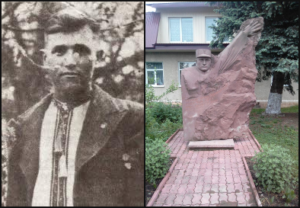
Yabluniv (Kosiv Raion) – Yurii Dolishnyak (1916–1948) was an officer in the Nazi-controlled local auxiliary police in the village of Kosmach who later became a UPA commander. Yabluniv also gave Dolishnyak a street which uses his nom de guerre “Bilyi”.
Left: Pavlo Vatsyk (Wikimedia Commons). Right: Vatsyk monument, Zarichchya (Google Maps). Image by Forward collage
Zarichchya (Nadvirna Raion) – A monument and street to Pavlo Vatsyk (1917–1946) in his home village; Vatsyk served in the Nazi-controlled local auxiliary police in his home region. Afterward, he became a UPA commander.
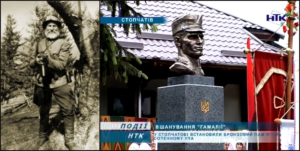
Zarichchya (Nadvirna Raion) – A monument and street to Pavlo Vatsyk (1917–1946) in his home village; Vatsyk served in the Nazi-controlled local auxiliary police in his home region. Afterward, he became a UPA commander.
Left: Vasyl Skryhunets aka Hamaliya (Wikimedia Commons). Right: Skryhunets bust, Stopchativ (Screenshot/YouTube). Image by Forward collage
Stopchativ – A monument to Vasyl Skryhunets (1893–1948) who served in the local auxiliary policebefore becoming a UPA commander. His monument uses his nom de guerre “Hamaliya”.
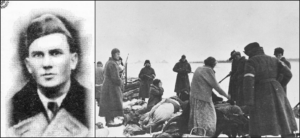
Stopchativ – A monument to Vasyl Skryhunets (1893–1948) who served in the local auxiliary policebefore becoming a UPA commander. His monument uses his nom de guerre “Hamaliya”.
Left: Oleksa Shum (Wikimedia Commons). Right: Ukrainian auxiliary police about to execute Jews, Chernihiv, 1942. Image by Forward collage
Lutsk and Kovel – Both locales have streets named for Oleksa Shum (1919–1944), member of the local auxiliary police that aided the Nazis in slaughtering about 18,000 Jews in the city of Kovel. Jews made up half of Kovel’s pre-war population; the community was virtually exterminated. Above right, Ukrainian police (with white armbands) preparing to execute Jews in Chernihiv, 1941.
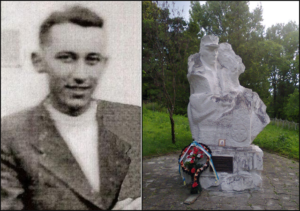
Lutsk and Kovel – Both locales have streets named for Oleksa Shum (1919–1944), member of the local auxiliary police that aided the Nazis in slaughtering about 18,000 Jews in the city of Kovel. Jews made up half of Kovel’s pre-war population; the community was virtually exterminated. Above right, Ukrainian police (with white armbands) preparing to execute Jews in Chernihiv, 1941.
Left: Roman Ryznyak (Wikimedia Commons). Right: Ryznyak monument, Truskavets (Wikimedia Commons). Image by Forward collage
Truskavets – A monument and street named for Roman Ryznyak (1921–1948), who served in Truskavets’ local auxiliary police. Ryznyak went on to become a regional commander in the Sluzhba Bezpeky – the OUN-B’s counterintelligence apparatus which spearheaded the ethnic cleansing of Poles in Volyn. See information on the Holocaust in Truskavets here.
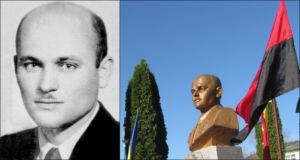
Truskavets – A monument and street named for Roman Ryznyak (1921–1948), who served in Truskavets’ local auxiliary police. Ryznyak went on to become a regional commander in the Sluzhba Bezpeky – the OUN-B’s counterintelligence apparatus which spearheaded the ethnic cleansing of Poles in Volyn. See information on the Holocaust in Truskavets here.
Left: Mykola Arsenych. Right: Arsenych bust, Nyzhniy Bereziv (Wikimedia Commons). Image by Forward collage
Nyzhniy Bereziv and five other locales – A monument to Mykola Arsenych (1910–1947), who headed the OUN-B’s Sluzhba Bezpeky. He also has a bas-relief in Nyzhniy Bereziv and streets in Dnipro, Kolomyia, L’viv, Sokal and Zviahel.
(Note: The Dnipro, L’viv and Sokal streets were added June 2025.)
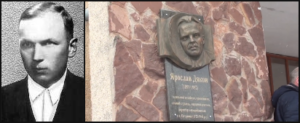
Nyzhniy Bereziv and five other locales – A monument to Mykola Arsenych (1910–1947), who headed the OUN-B’s Sluzhba Bezpeky. He also has a bas-relief in Nyzhniy Bereziv and streets in Dnipro, Kolomyia, L’viv, Sokal and Zviahel.
(Note: The Dnipro, L’viv and Sokal streets were added June 2025.)
Left: Yaroslav Dyakon (Wikimedia Commons). Right: Dyakon plaque, Petranka (Screenshot/YouTube). Image by Forward collage
Petranka and Dev’yatnyky – A plaque to Yaroslav Dyakon (1913–1948), who headed the Sluzhba Bezpeky in 1947–1948 after Mykola Arsenych (see entry above) was killed. Prior to that, Dyakon was head of the local auxiliary police in the town of Bibrka. In 1942, most Jews from the Bibrka ghetto were deported to the Belzec death camp; in 1943, local auxiliary police helped the Germans burn Bibrka’s remaining Jews alive. Dyakon also has a school in Dev’yatnyky. See Yahad In-Unum eyewitness testimony of the Holocaust in Bibrka.
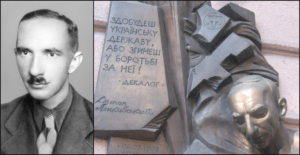
Petranka and Dev’yatnyky – A plaque to Yaroslav Dyakon (1913–1948), who headed the Sluzhba Bezpeky in 1947–1948 after Mykola Arsenych (see entry above) was killed. Prior to that, Dyakon was head of the local auxiliary police in the town of Bibrka. In 1942, most Jews from the Bibrka ghetto were deported to the Belzec death camp; in 1943, local auxiliary police helped the Germans burn Bibrka’s remaining Jews alive. Dyakon also has a school in Dev’yatnyky. See Yahad In-Unum eyewitness testimony of the Holocaust in Bibrka.
Left: Stepan Lenkavskyi (Wikimedia Commons). Right: Lenkavskyi bas-relief, Ivano-Frankivsk (Wikimedia Commons). Image by Forward collage
Ivano-Frankivsk and six other locales – Ivano-Frankivsk has a bas-relief (above right), monument and street to Stepan Lenkavskyi (1904–1977), one of the main OUN ideologues who led the OUN-B after Stepan Bandera was assassinated in 1959. Lenkavskyi authored The Decalogue of a Ukrainian Nationalist, a set of tenets considered foundational to the organization. He was also a murderous antisemite: “We will adopt any methods that lead to their destruction,” Lenkavskyi exhorted at an OUN-B council which was discussing the fate of Jews.
Lenkavskyi who, like many in the OUN-B leadership, had successfully emigrated to the West, also has a monument in Uhornyky; a plaque in Fit’kiv and another on a joint monument to him and other OUN leaders in Morshyn; and streets in Bryukhovychi, Lutsk, Stryi, Yasenytsya-Sil’na and Zahvizdya.
(Note: The Lutsk street was added March 2024; the Bryukhovychi and Yasenytsya-Sil’na streets were added June 2025.)
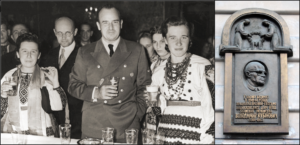
Ivano-Frankivsk and six other locales – Ivano-Frankivsk has a bas-relief (above right), monument and street to Stepan Lenkavskyi (1904–1977), one of the main OUN ideologues who led the OUN-B after Stepan Bandera was assassinated in 1959. Lenkavskyi authored The Decalogue of a Ukrainian Nationalist, a set of tenets considered foundational to the organization. He was also a murderous antisemite: “We will adopt any methods that lead to their destruction,” Lenkavskyi exhorted at an OUN-B council which was discussing the fate of Jews.

Lenkavskyi who, like many in the OUN-B leadership, had successfully emigrated to the West, also has a monument in Uhornyky; a plaque in Fit’kiv and another on a joint monument to him and other OUN leaders in Morshyn; and streets in Bryukhovychi, Lutsk, Stryi, Yasenytsya-Sil’na and Zahvizdya.

(Note: The Lutsk street was added March 2024; the Bryukhovychi and Yasenytsya-Sil’na streets were added June 2025.)
Left: Volodymyr Kubiyovych, second from left, with Third Reich Governor-General of Poland Hans Frank, third from left, harvest fair festival, Krakow, October 24, 1943 (National Digital Archives Poland via Wikimedia Commons). Right: Kubiyovych plaque, L’viv (Wikimedia Commons). Image by Forward collage
L’viv and two other locales – Volodymyr Kubiyovych (1900–1985) was a Ukrainian leader who closely worked with Hans Frank, the Governor-General of Poland responsible for orchestrating the Holocaust in western Ukraine. Above left, Kubiyovych (second from left) attends a function with Frank. Kubiyovych leveraged his relationship with the Third Reich to convince the Nazis to create a Ukrainian unit in Waffen-SS, the military arm of the Nazi Party responsible for the Holocaust. His persistent lobbying was instrumental in the formation of the 14th Waffen Grenadier Division of the SS (1st Galician) aka SS Galichina in 1943. It went on to commit war crimes such as the 1944 Huta Pieniacka massacre, when its fighters burned 500–1,000 Polish villagers alive.
Kubiyovych’s genocidal activities include chairing L’viv’s Ukrainian Central Committee, a collaborationist organization recognized by the Third Reich. In addition to helping organize and recruit local auxiliary police, the committee warned Ukrainians that anyone helping Jews hide would be severely prosecuted (below left). Thanks to such efforts, L’viv’s thriving Jewish community, which had comprised a third of L’viv prewar population, was wiped out; out of 200,000, less than 800 survived (which makes for a 0.4% survival rate).
While Hans Frank was hanged for crimes against humanity in Nuremberg, Kubiyovych moved to the West where he was celebrated as a geographer and activist. He even edited a book about the SS division he helped create. In addition to his plaque and street in L’viv, Kubiyovych has streets in Ivano-Frankivsk and Kolomyia. Below right, Kubiyovych (circled) gives the Nazi salute at a 1943 rally. In 2020, the World Jewish Congress and the Jewish Confederation of Ukraine denounced Kyiv’s attempt to honor Kubiyovych.
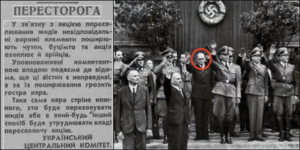
L’viv and two other locales – Volodymyr Kubiyovych (1900–1985) was a Ukrainian leader who closely worked with Hans Frank, the Governor-General of Poland responsible for orchestrating the Holocaust in western Ukraine. Above left, Kubiyovych (second from left) attends a function with Frank. Kubiyovych leveraged his relationship with the Third Reich to convince the Nazis to create a Ukrainian unit in Waffen-SS, the military arm of the Nazi Party responsible for the Holocaust. His persistent lobbying was instrumental in the formation of the 14th Waffen Grenadier Division of the SS (1st Galician) aka SS Galichina in 1943. It went on to commit war crimes such as the 1944 Huta Pieniacka massacre, when its fighters burned 500–1,000 Polish villagers alive.
Kubiyovych’s genocidal activities include chairing L’viv’s Ukrainian Central Committee, a collaborationist organization recognized by the Third Reich. In addition to helping organize and recruit local auxiliary police, the committee warned Ukrainians that anyone helping Jews hide would be severely prosecuted (below left). Thanks to such efforts, L’viv’s thriving Jewish community, which had comprised a third of L’viv prewar population, was wiped out; out of 200,000, less than 800 survived (which makes for a 0.4% survival rate).
While Hans Frank was hanged for crimes against humanity in Nuremberg, Kubiyovych moved to the West where he was celebrated as a geographer and activist. He even edited a book about the SS division he helped create. In addition to his plaque and street in L’viv, Kubiyovych has streets in Ivano-Frankivsk and Kolomyia. Below right, Kubiyovych (circled) gives the Nazi salute at a 1943 rally. In 2020, the World Jewish Congress and the Jewish Confederation of Ukraine denounced Kyiv’s attempt to honor Kubiyovych.
Left: Ukrainian Central Committee announcement warning Ukrainians not to aid Jews, printed in a L’viv newspaper, August 1942 (Eduard Dolinsky). Right: Kubiyovych, circled, giving Nazi salute, SS Galichina parade, L’viv, 1943. Image by Forward collage
***
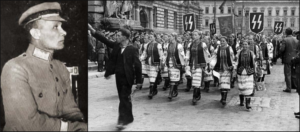
***
Left: Viktor Kurmanovych (Wikimedia Commons). Right: Parade in honor of the 14th Waffen Grenadier Division of the SS (1st Galician), L’viv, 1943. Image by Forward collage
L’viv and Sokal – Both have streets named for Viktor Kurmanovych (1876–1945), one of the founders of SS Galichina. Above right, festivities in L’viv in honor of SS Galichina, 1943. Note the SS bolts, swastikas and SS Galichina lion and crowns placards.
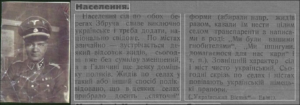
L’viv and Sokal – Both have streets named for Viktor Kurmanovych (1876–1945), one of the founders of SS Galichina. Above right, festivities in L’viv in honor of SS Galichina, 1943. Note the SS bolts, swastikas and SS Galichina lion and crowns placards.
Left: Waffen-Obersturmführer Mykola Uhryn-Bezhrishny in his uniform from the 14th Waffen Grenadier Division of the SS (1st Galician) (Eduard Dolinsky). Right: Rohatyn’ske Slovo celebrating the destruction of Ukraine’s Jews, November 1, 1941 (Libraria.ua). Image by Forward collage
Rohatyn – A street and museum for Mykola Uhryn-Bezhrishny (1883–1960), who advocated for SS Galichina’s creation and served in the division under the rank of Waffen-Obersturmführer.
Prior to joining SS Galichina, Uhryn-Bezhrishny published the Rohatyn’ske Slovo newspaper which praised the Nazi invasion of Ukraine, ran paeans to “Adolf Hitler and his fearless knights,” and blamedUkraine’s problems on “Judeo-Communists.” It also recruited Ukrainians for the German-controlled local auxiliary police which helped eradicate Rohatyn’s Jewish community.
Above right, Rohatyn’ske Slovo article from November 1941 celebrates the annihilation of Ukraine’s Jews: “the cities still have a certain percentage of Jews, albeit much diminished…Jews in the villages have been liquidated, one way or another….in some villages this took on a festive mood – for example, Jews were forced to march with signs saying ‘We are your tormentors’.”
The Uhryn-Bezhrishny museum is part of the Rohatyn Museum Complex which includes the nearby Church of the Holy Spirit, a medieval wooden church. In 2013, the church was designated as a UNESCO World Heritage Site. It’s important to note that UNESCO lists only the church and not the museum as part of the heritage site; however the formal link between a UNESCO-designated site and a “museum” glorifying a Waffen-SS officer can be easily used to whitewash Uhryn-Bezhrishny.
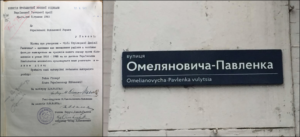
Rohatyn – A street and museum for Mykola Uhryn-Bezhrishny (1883–1960), who advocated for SS Galichina’s creation and served in the division under the rank of Waffen-Obersturmführer.
Prior to joining SS Galichina, Uhryn-Bezhrishny published the Rohatyn’ske Slovo newspaper which praised the Nazi invasion of Ukraine, ran paeans to “Adolf Hitler and his fearless knights,” and blamedUkraine’s problems on “Judeo-Communists.” It also recruited Ukrainians for the German-controlled local auxiliary police which helped eradicate Rohatyn’s Jewish community.
Above right, Rohatyn’ske Slovo article from November 1941 celebrates the annihilation of Ukraine’s Jews: “the cities still have a certain percentage of Jews, albeit much diminished…Jews in the villages have been liquidated, one way or another….in some villages this took on a festive mood – for example, Jews were forced to march with signs saying ‘We are your tormentors’.”
The Uhryn-Bezhrishny museum is part of the Rohatyn Museum Complex which includes the nearby Church of the Holy Spirit, a medieval wooden church. In 2013, the church was designated as a UNESCO World Heritage Site. It’s important to note that UNESCO lists only the church and not the museum as part of the heritage site; however the formal link between a UNESCO-designated site and a “museum” glorifying a Waffen-SS officer can be easily used to whitewash Uhryn-Bezhrishny.
Left: Mykhailo Omelyanovych-Pavlenko letter, May 5, 1943 (Eduard Dolinsky). Right: Omelyanovych-Pavlenko Street, Kyiv (Eduard Dolinsky). Image by Forward collage
Kyiv and six other locales – A major street in Ukraine’s capital named for Mykhailo Omelyanovych-Pavlenko (1878–1952). Omelyanovych-Pavlenko was a hero of Ukrainian liberation movements of the WWI era. By the time WWII came around, he was recruiting soldiers for the Third Reich via the Ukrainian Liberation Army, an umbrella organization which funneled Ukrainian volunteers to various Nazi military formations.
Omelyanovych-Pavlenko was overjoyed to learn of Hitler greenlighting SS Galichina’s creation – “Hail Hitler! Hail the Ukrainian Army!” he wrote in a letter celebrating the news (above left). He also has streets in Dnipro, Kropyvnytskyi, Kryvyi Rih, Odesa, Pervomaisk (Mykolayiv Oblast) and Voznesensk. Below, Omelyanovych-Pavlenko (sitting) with SS Galichina officers, 1943.
(Note: The Kropyvnytskyi, Kryvyi Rih and Odesa streets were added June 2025.)
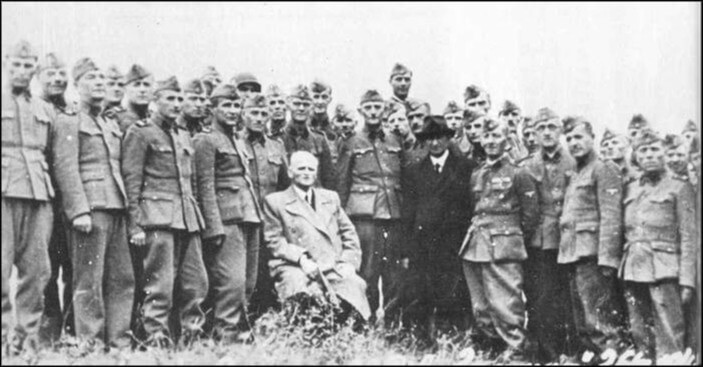 Mykhailo Omelyanovych-Pavlenko, sitting, with officers of the 14th Waffen Grenadier Division of the SS (1st Galician), Lešany, German-occupied Czechoslovakia, September 26, 1943 (Wikimedia Commons). Image by Lev Golinkin
***
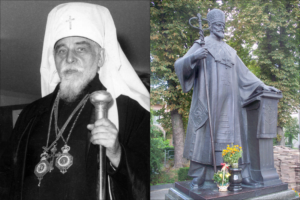
Kyiv and six other locales – A major street in Ukraine’s capital named for Mykhailo Omelyanovych-Pavlenko (1878–1952). Omelyanovych-Pavlenko was a hero of Ukrainian liberation movements of the WWI era. By the time WWII came around, he was recruiting soldiers for the Third Reich via the Ukrainian Liberation Army, an umbrella organization which funneled Ukrainian volunteers to various Nazi military formations.
Omelyanovych-Pavlenko was overjoyed to learn of Hitler greenlighting SS Galichina’s creation – “Hail Hitler! Hail the Ukrainian Army!” he wrote in a letter celebrating the news (above left). He also has streets in Dnipro, Kropyvnytskyi, Kryvyi Rih, Odesa, Pervomaisk (Mykolayiv Oblast) and Voznesensk. Below, Omelyanovych-Pavlenko (sitting) with SS Galichina officers, 1943.
(Note: The Kropyvnytskyi, Kryvyi Rih and Odesa streets were added June 2025.)
Mykhailo Omelyanovych-Pavlenko, sitting, with officers of the 14th Waffen Grenadier Division of the SS (1st Galician), Lešany, German-occupied Czechoslovakia, September 26, 1943 (Wikimedia Commons). Image by Lev Golinkin***
Left: Iosif Slipyi (Wikimedia Commons). Right: Slipyi statue, Ternopil (Wikimedia Commons). Image by Forward collage
Ternopil and 24 other locales – The Ukrainian Greek Catholic Church played an important role in SS Galichina’s creation. Bishop Iosif Slipyi (1892–1984) was the Church’s point man. He celebrated mass at SS Galichina’s founding and even furnished the division with priests who served as chaplains. Prior to that, Slipyi served as first deputy in the 1941 self-declared OUN government which had pledged allegiance to Hitler (see Yaroslav Stetsko entry for more).
According to Slipyi’s own memoirs, by 1943 he was well aware of the fate Germany had for the Jews; he still helped provide the Third Reich with SS recruits.
In 1983, forty years later, Slipyi remained proud of SS Galichina. By then, Slipyi, who had spent years in Soviet labor camps, was in Rome. He commemorated the anniversary of SS Galichina’s founding with praise.
“Let the memory of Ukrainian Galichian Division live with us forever as a testament to nations that we strive for freedom, statehood and are prepared for the greatest sacrifices for truth, fairness and peace to be in our land,” he proclaimed, calling on the faithful to pray for SS men.
Slipyi has a statue, seminary, school, street and two plaques in Ternopil; a museum, memorial plaque, bust, school and street in Zazdrist’; a street, museum, center at the Ukrainian Catholic University and massive bas-relief in L’viv; a plaque in Kharkiv; a statue in Truskavets; streets in Bila, Borschiv, Boryatyn, Chervonohrad, Chortkiv, Drohobych, Hrabovets (L’viv Oblast), Ivano-Frankivsk, Kalush, Kolomyia, Mykulyntsi, Radekhiv, Rivne (Mykolayiv Oblast), Rozvadiv, Rudne, Snihurivka, Zady, Zalishchyky and Zhovkva; and a square in Stryi.
Below left, Slipyi (third from right) welcomes Hans Frank to L’viv, August 1, 1941. Four years later, Frank would be hanged for crimes against humanity in Nuremberg. Below right, Ukrainian Greek Catholic bishop Josaphat Kotsylovsky celebrating mass at an SS Galichina ceremony in Przemyśl, summer 1943; note the division’s lion and crowns insignia. See the Canada, Italy and U.S. sections for more Slipyi glorification.
(Note: The Boryatyn street was added June 2025.)
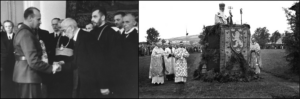
Ternopil and 24 other locales – The Ukrainian Greek Catholic Church played an important role in SS Galichina’s creation. Bishop Iosif Slipyi (1892–1984) was the Church’s point man. He celebrated mass at SS Galichina’s founding and even furnished the division with priests who served as chaplains. Prior to that, Slipyi served as first deputy in the 1941 self-declared OUN government which had pledged allegiance to Hitler (see Yaroslav Stetsko entry for more).
According to Slipyi’s own memoirs, by 1943 he was well aware of the fate Germany had for the Jews; he still helped provide the Third Reich with SS recruits.
In 1983, forty years later, Slipyi remained proud of SS Galichina. By then, Slipyi, who had spent years in Soviet labor camps, was in Rome. He commemorated the anniversary of SS Galichina’s founding with praise.
“Let the memory of Ukrainian Galichian Division live with us forever as a testament to nations that we strive for freedom, statehood and are prepared for the greatest sacrifices for truth, fairness and peace to be in our land,” he proclaimed, calling on the faithful to pray for SS men.
Slipyi has a statue, seminary, school, street and two plaques in Ternopil; a museum, memorial plaque, bust, school and street in Zazdrist’; a street, museum, center at the Ukrainian Catholic University and massive bas-relief in L’viv; a plaque in Kharkiv; a statue in Truskavets; streets in Bila, Borschiv, Boryatyn, Chervonohrad, Chortkiv, Drohobych, Hrabovets (L’viv Oblast), Ivano-Frankivsk, Kalush, Kolomyia, Mykulyntsi, Radekhiv, Rivne (Mykolayiv Oblast), Rozvadiv, Rudne, Snihurivka, Zady, Zalishchyky and Zhovkva; and a square in Stryi.


.jpg)
Below left, Slipyi (third from right) welcomes Hans Frank to L’viv, August 1, 1941. Four years later, Frank would be hanged for crimes against humanity in Nuremberg. Below right, Ukrainian Greek Catholic bishop Josaphat Kotsylovsky celebrating mass at an SS Galichina ceremony in Przemyśl, summer 1943; note the division’s lion and crowns insignia. See the Canada, Italy and U.S. sections for more Slipyi glorification.
(Note: The Boryatyn street was added June 2025.)
Left: Iosif Slipyi, third from right, part of an official delegation to Third Reich Governor-General of Poland Hans Frank, left, L’viv, August 1, 1941 (National Digital Archives Poland). Right: Josaphat Kotsylovsky, at pulpit, celebrates mass at an SS Galichina ceremony, Przemyśl, summer 1943. Image by Forward collage
***
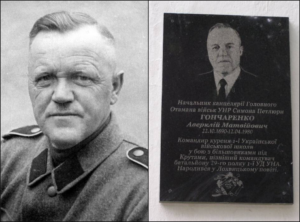
***
Left: Waffen-Hauptsturmführer Averkiy Honcharenko of the 14th Waffen Grenadier Division of the SS (1st Galician) (Wikimedia Commons). Right: Honcharenko plaque, Lokhvytsia (Eduard Dolinsky). Image by Forward collage
Lokhvytsia and three other locales – Lokhvytsia’s plaque celebrating Averkiy Honcharenko (1890–1980) refers to him as a battalion commander in the 1st Division of the UNA aka SS Galichina. SS Galichina was renamed the 1st Division of the Ukrainian National Army (UNA) toward the very end of WWII. Using the innocuous-sounding “1st Division of the UNA” instead of SS Galichina is a tactic that allows whitewashers to publicly honor SS Galichina soldiers without the attention-grabbing “SS”. It’s common both in Ukraine and in the West (see the Austria, Australia and Canada sections).
After his service to Nazi Germany, Honcharenko, who rose to the rank of Waffen-Hauptsturmführer in the Waffen-SS, emigrated to America. This SS officer has additional plaques in Tulchyn and Varva and a street in Brovary. See coverage of Ukrainian Waffen-SS veterans being resettled into the U.K. and Canada in the Guardian, Daily Mail, the National Post and the Jewish News of Northern California.
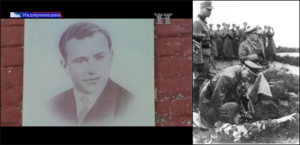
Lokhvytsia and three other locales – Lokhvytsia’s plaque celebrating Averkiy Honcharenko (1890–1980) refers to him as a battalion commander in the 1st Division of the UNA aka SS Galichina. SS Galichina was renamed the 1st Division of the Ukrainian National Army (UNA) toward the very end of WWII. Using the innocuous-sounding “1st Division of the UNA” instead of SS Galichina is a tactic that allows whitewashers to publicly honor SS Galichina soldiers without the attention-grabbing “SS”. It’s common both in Ukraine and in the West (see the Austria, Australia and Canada sections).
After his service to Nazi Germany, Honcharenko, who rose to the rank of Waffen-Hauptsturmführer in the Waffen-SS, emigrated to America. This SS officer has additional plaques in Tulchyn and Varva and a street in Brovary. See coverage of Ukrainian Waffen-SS veterans being resettled into the U.K. and Canada in the Guardian, Daily Mail, the National Post and the Jewish News of Northern California.
Left: Vasyl Kosiuk plaque, Lanchyn (Screenshot/YouTube). Right: Reichsführer-SS Heinrich Himmler, kneeling, inspecting troops of the 14th Waffen Grenadier Division of the SS (1st Galician), May 6, 1944, Neuhammer (now Świętoszów), Poland (National Digital Archives Poland). Image by Forward collage
Lanchyn – This town’s plaque honoring Vasyl Kosiuk (1921–1984) calls him a veteran of the 1st Division of the UNA (see above). After the war, Kosiuk took the traditional Nazi path, ending up in Argentina. Above right, Heinrich Himmler inspecting SS Galichina, May 6, 1944, Neuhammer (now Świętoszów), Poland.
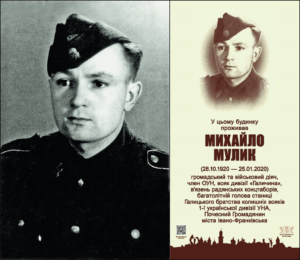
Lanchyn – This town’s plaque honoring Vasyl Kosiuk (1921–1984) calls him a veteran of the 1st Division of the UNA (see above). After the war, Kosiuk took the traditional Nazi path, ending up in Argentina. Above right, Heinrich Himmler inspecting SS Galichina, May 6, 1944, Neuhammer (now Świętoszów), Poland.
Left: Mykhailo Mulyk (Wikimedia Commons). Right: Mulyk plaque, detail, part of the “Ivano-Frankivsk – A City of Heroes” program, Ivano-Frankivsk (Eduard Dolinsky). Image by Forward collage
Ivano-Frankivsk – In 2013, Ivano-Frankivsk inaugurated the “Ivano-Frankivsk – A Place of Heroes” program which unveiled memorial plaques throughout the city and environs. These “heroes” include Volodymyr Malkosh (1924–2009), Waffen-Unterscharführer in SS Galichina. In a 2010 interview about his SS service, Malkosh claimed he fought “not for Hitler but against Stalin,” a common whitewashing lie designed to deny fighting in the Waffen-SS.
In the same interview, Malkosh reminisced about how under Nazi rule, with the Jews (whom he called “capitalists” and “merchants”) exterminated, ethnic Ukrainians received more rights. As an example, he mentioned that under the Nazis, L’viv’s higher education schools became composed of 90% ethnic Ukrainians. Malkosh didn’t explain the reason for the sudden demographic change: the schools’ Jewish students had been liquidated by Germans and Ukrainian collaborators, which left mostly ethnic Ukrainian students.
Another “hero” commemorated by Ivano-Frankivsk’s program is Stepan Koval (1914–2001), commander of Lutsk’s Ukrainian police academy established with the approval of the Nazis (the academy’s insignia prominently featured a swastika). Lutsk’s local auxiliary police played a key role in the murder of over 20,000 of the city’s Jews. Later, Koval commanded a unit in the UPA which participated in the ethnic cleansing of Polish villages. His plaque is in his home village of Mykytyntsi, right outside Ivano-Frankivsk.
The heroes program also erected a plaque for Mykhailo Mulyk (1920–2020), SS Galichina veteran who annually celebrated the unit’s founding. (The plaque features a photograph of Mulyk in his SS uniform but with the SS insignia blurred out; see above) Mulyk received a separate memorial sign on Ivano-Frankivsk’s walk of fame as well. See the JTA on condemnation of SS Galichina marches which frequently feature Nazi salutes.
These plaques are in Ivano-Frankivsk, where the Nazis together with Ukrainian collaborators, exterminated over 20,000 Jews; no more than 1,500 of the city’s Jews survived.
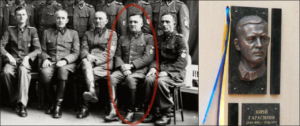
Ivano-Frankivsk – In 2013, Ivano-Frankivsk inaugurated the “Ivano-Frankivsk – A Place of Heroes” program which unveiled memorial plaques throughout the city and environs. These “heroes” include Volodymyr Malkosh (1924–2009), Waffen-Unterscharführer in SS Galichina. In a 2010 interview about his SS service, Malkosh claimed he fought “not for Hitler but against Stalin,” a common whitewashing lie designed to deny fighting in the Waffen-SS.
In the same interview, Malkosh reminisced about how under Nazi rule, with the Jews (whom he called “capitalists” and “merchants”) exterminated, ethnic Ukrainians received more rights. As an example, he mentioned that under the Nazis, L’viv’s higher education schools became composed of 90% ethnic Ukrainians. Malkosh didn’t explain the reason for the sudden demographic change: the schools’ Jewish students had been liquidated by Germans and Ukrainian collaborators, which left mostly ethnic Ukrainian students.
Another “hero” commemorated by Ivano-Frankivsk’s program is Stepan Koval (1914–2001), commander of Lutsk’s Ukrainian police academy established with the approval of the Nazis (the academy’s insignia prominently featured a swastika). Lutsk’s local auxiliary police played a key role in the murder of over 20,000 of the city’s Jews. Later, Koval commanded a unit in the UPA which participated in the ethnic cleansing of Polish villages. His plaque is in his home village of Mykytyntsi, right outside Ivano-Frankivsk.
The heroes program also erected a plaque for Mykhailo Mulyk (1920–2020), SS Galichina veteran who annually celebrated the unit’s founding. (The plaque features a photograph of Mulyk in his SS uniform but with the SS insignia blurred out; see above) Mulyk received a separate memorial sign on Ivano-Frankivsk’s walk of fame as well. See the JTA on condemnation of SS Galichina marches which frequently feature Nazi salutes.
These plaques are in Ivano-Frankivsk, where the Nazis together with Ukrainian collaborators, exterminated over 20,000 Jews; no more than 1,500 of the city’s Jews survived.
Left: Yurii Harasymiv, circled (Eduard Dolinsky). Right: Harasymiv plaque, Kalush (Eduard Dolinsky). Image by Forward collage
Kalush – In 2018 this city unveiled a bas-relief honoring SS Galichina officer Yurii Harasymiv (1899–1975). Media coverage of the event described Harasymiv as a Waffen-SS officer the way American media describes U.S. Army veterans, which isn’t surprising given how openly this SS division is celebrated in Ukraine. Above left, Garasymiv (circled) at SS training, 1943.
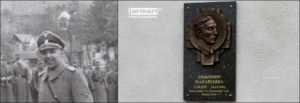
Kalush – In 2018 this city unveiled a bas-relief honoring SS Galichina officer Yurii Harasymiv (1899–1975). Media coverage of the event described Harasymiv as a Waffen-SS officer the way American media describes U.S. Army veterans, which isn’t surprising given how openly this SS division is celebrated in Ukraine. Above left, Garasymiv (circled) at SS training, 1943.
Left: Waffen-Obersturmführer Lyubomir Makarushka of the 14th Waffen Grenadier Division of the SS (1st Galician) (Eduard Dolinsky). Right: Makarushka plaque, Sivka Voinylivska (Screenshot/YouTube). Image by Forward collage
Sivka-Voinylivska – A plaque to Lyubomir Makarushka (1899–1986), Waffen-Obersturmführer in SS Galichina. After the war, Makarushka lived in West Germany. Note the SS Galichina collar patch insignia on the plaque; the Anti-Defamation League classifies SS divisional insignia as neo-Nazi hate symbols.
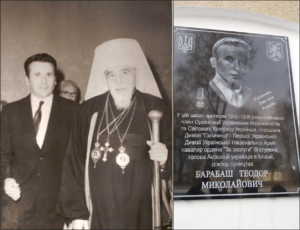
Sivka-Voinylivska – A plaque to Lyubomir Makarushka (1899–1986), Waffen-Obersturmführer in SS Galichina. After the war, Makarushka lived in West Germany. Note the SS Galichina collar patch insignia on the plaque; the Anti-Defamation League classifies SS divisional insignia as neo-Nazi hate symbols.

Left: Teodor Barabash, left, with Iosif Slipyi. Right: Barabash plaque, Malyi Khodachkiv. Image by Forward collage
Malyi Khodachkiv – a plaque honoring SS Galichina fighter Teodor Barabash (1923–2014). After the war, Barabash emigrated to Spain, where he became a businessman and leader of the country’s Ukrainian diaspora. Above left, Barabash with Iosif Slipyi who was deeply involved in the creation of SS Galichina (see entry above).
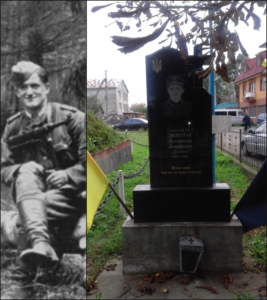
Malyi Khodachkiv – a plaque honoring SS Galichina fighter Teodor Barabash (1923–2014). After the war, Barabash emigrated to Spain, where he became a businessman and leader of the country’s Ukrainian diaspora. Above left, Barabash with Iosif Slipyi who was deeply involved in the creation of SS Galichina (see entry above).
Left: Volodymyr Deputat (Eduard Dolinsky). Right: Deputat memorial, Perehyn’ske (Eduard Dolinsky). Image by Forward collage
Perehyn’ske – A memorial to hometown fighter Volodymyr Deputat (1918–1946) who served in SS Galichina before joining the UPA.
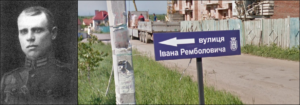
Perehyn’ske – A memorial to hometown fighter Volodymyr Deputat (1918–1946) who served in SS Galichina before joining the UPA.
Left: Ivan Rembolovich (Wikimedia Commons). Right: Ivan Rembolovich Street, Ivano-Frankivsk (Google Maps). Image by Forward collage
Ivano-Frankivsk and Chernihiv – Both have streets for Ivan Rembolovich (1897–1950), decorated SS Galichina officer.
(Note: The Chernihiv street was added August 2023.)
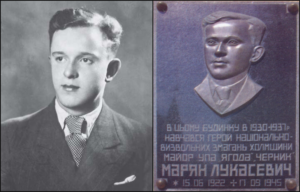
Ivano-Frankivsk and Chernihiv – Both have streets for Ivan Rembolovich (1897–1950), decorated SS Galichina officer.
(Note: The Chernihiv street was added August 2023.)
Left: Mar’yan Lukasevich (Wikimedia Commons). Right: Lukasevich plaque, Ternopil. Image by Forward collage
Ternopil – On the façade of a Ternopil school is a plaque celebrating one of its graduates, Mar’yan Lukasevich (1922–1945). Lukasevich served in SS Galichina before becoming a UPA commander. The plaque describes him as a hero of the “national liberation” movement.
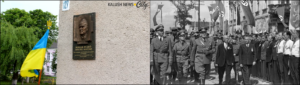
Ternopil – On the façade of a Ternopil school is a plaque celebrating one of its graduates, Mar’yan Lukasevich (1922–1945). Lukasevich served in SS Galichina before becoming a UPA commander. The plaque describes him as a hero of the “national liberation” movement.
Left: Roman Rudyi plaque, Voinyliv (Screenshot/YouTube). Right: Governor of Galizia Otto Wächter, far left, and Third Reich Governor-General of Poland Hans Frank, third from left, inspect the 14th Waffen Grenadier Division of the SS (1st Galician), L’viv, June 1943 (National Digital Archives Poland). Image by Forward collage
Voinyliv – A plaque to town native Roman Rudyi (1923–2005), who served in SS Galichina. The plaque calls him a “civil and political activist and a political prisoner.” Above right, Governor of Galizia Otto Wächter (far left) and Governor-General of Poland Hans Frank (third from left) inspect SS Galichina volunteers in L’viv, June 1943.
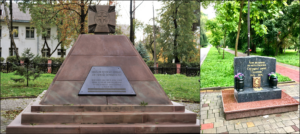
Voinyliv – A plaque to town native Roman Rudyi (1923–2005), who served in SS Galichina. The plaque calls him a “civil and political activist and a political prisoner.” Above right, Governor of Galizia Otto Wächter (far left) and Governor-General of Poland Hans Frank (third from left) inspect SS Galichina volunteers in L’viv, June 1943.
Left: Monument to SS Galichina and the Ukrainian Insurgent Army, Ivano-Frankivsk (Wikimedia Commons). Right: memorial commemorating SS Galichina’s founding, Topil’che Park, Ternopil (Google Maps). Image by Forward collage
Ivano-Frankivsk and two other locales – Both Ivano-Frankivsk and Ternopil have streets and memorials dedicated to the SS Galichina division as a whole. Ivano-Frankivsk’s memorial (above left) thanks the “heroes” of the Ukrainian Division Galicia (another name for SS Galichina) as well as OUN and UPA fighters.
Ternopil commemorates SS Galichina’s founding with a promenade in the city’s beautiful Topil’che Park; above right, a memorial at one end of the promenade. The city also has an SS Galichina street. Additionally, there’s an SS Galichina museum in L’viv. For more SS Galichina memorials, see the Austria, Australia and Canada sections.
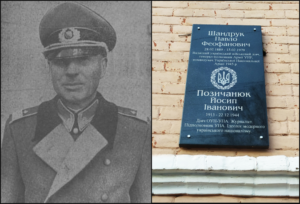
Ivano-Frankivsk and two other locales – Both Ivano-Frankivsk and Ternopil have streets and memorials dedicated to the SS Galichina division as a whole. Ivano-Frankivsk’s memorial (above left) thanks the “heroes” of the Ukrainian Division Galicia (another name for SS Galichina) as well as OUN and UPA fighters.
Ternopil commemorates SS Galichina’s founding with a promenade in the city’s beautiful Topil’che Park; above right, a memorial at one end of the promenade. The city also has an SS Galichina street. Additionally, there’s an SS Galichina museum in L’viv. For more SS Galichina memorials, see the Austria, Australia and Canada sections.
Left: Pavlo Shandruk (Eduard Dolinsky). Right: Plaque to Shandruk and Iosyp Pozychanyuk on the “Wall of Heroes,” Nizhyn (Wikimedia Commons). Image by Forward collage
Nizhyn and four other locales – The city’s “Wall of Heroes” has a plaque jointly honoring Pavlo Shandruk (1889–1979) and Iosyp Pozychanyuk (1913–1944). Shandruk, one of the highest ranked Ukrainians in the Third Reich, was commanding general of the Ukrainian National Army, a part of the Wehrmacht (Nazi Germany’s armed forces). After the war, Shandruk (above left) moved to America. He also has a plaque on a school in Borsuky and streets in Ivano-Frankivsk and Pervomaisk (Mykolayiv Oblast).
Pozychanyuk was minister of propaganda in the OUN-B’s 1941 Nazi collaborationist government (see Ivan Klymiv entry above for more). Later, Pozychanyuk became a lieutenant-colonel running propaganda for the UPA. He also has a memorial bas-relief in his home village of Dashiv.
(Note: Shandruk’s Pervomaisk (Mykolayiv Oblast) street was added June 2025.)
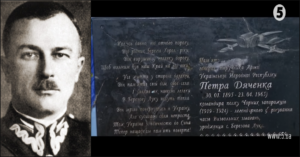
Nizhyn and four other locales – The city’s “Wall of Heroes” has a plaque jointly honoring Pavlo Shandruk (1889–1979) and Iosyp Pozychanyuk (1913–1944). Shandruk, one of the highest ranked Ukrainians in the Third Reich, was commanding general of the Ukrainian National Army, a part of the Wehrmacht (Nazi Germany’s armed forces). After the war, Shandruk (above left) moved to America. He also has a plaque on a school in Borsuky and streets in Ivano-Frankivsk and Pervomaisk (Mykolayiv Oblast).
Pozychanyuk was minister of propaganda in the OUN-B’s 1941 Nazi collaborationist government (see Ivan Klymiv entry above for more). Later, Pozychanyuk became a lieutenant-colonel running propaganda for the UPA. He also has a memorial bas-relief in his home village of Dashiv.
(Note: Shandruk’s Pervomaisk (Mykolayiv Oblast) street was added June 2025.)
Left: Petro Dyachenko (Wikimedia Commons). Right: Dyachenko plaque, Berezova Luka (Screenshot/YouTube). Image by Forward collage
Berezova Luka and six other locales – In the village of Berezova Luka is a memorial plaque and museum to Petro Dyachenko (1895–1965). Dyachenko, like Pavlo Shandruk (see entry above), was a general in the Ukrainian National Army; for his services, Dyachenko was personally awarded the Iron Cross by Third Reich general Wilhelm Schmalz. Toward the end of the war, Dyacheko was also attached to SS Galichina. Dyachenko, who later emigrated to America, also has streets in Bila Tserkva, Nikopol’, Pervomaisk (Mykolayiv Oblast), Voznesensk, Zhmerynka and Zolotonosha.
(Poznámka: Ulica Nikopol' bola pridaná v marci 2024; ulice Bila Cerkva, Pervomajsk (oblasť Mykolajiv), Zhmerynka a Zolotonosha boli pridané v júni 2025.)
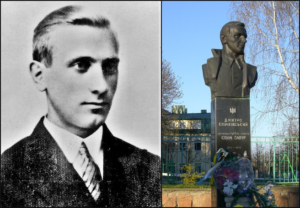
Berezova Luka and six other locales – In the village of Berezova Luka is a memorial plaque and museum to Petro Dyachenko (1895–1965). Dyachenko, like Pavlo Shandruk (see entry above), was a general in the Ukrainian National Army; for his services, Dyachenko was personally awarded the Iron Cross by Third Reich general Wilhelm Schmalz. Toward the end of the war, Dyacheko was also attached to SS Galichina. Dyachenko, who later emigrated to America, also has streets in Bila Tserkva, Nikopol’, Pervomaisk (Mykolayiv Oblast), Voznesensk, Zhmerynka and Zolotonosha.
(Poznámka: Ulica Nikopol' bola pridaná v marci 2024; ulice Bila Cerkva, Pervomajsk (oblasť Mykolajiv), Zhmerynka a Zolotonosha boli pridané v júni 2025.)
Zľava: Dmytro Kliachkivskyi alias Klym Savur (Wikimedia Commons). Vpravo: busta Kliachkivského, Zbarazh (Wikimedia Commons). Obrázok podľa koláže vpred
Zbaraž (Ternopilská oblasť) a osem ďalších miest – Významný vodca OUN Dmytro Kliachkivskyj (1911 – 1945), známy aj ako Klim Savur, zohral kľúčovú úlohu pri formovaní UPA v roku 1943. Kliachkivskyj sa nakoniec stal veliteľom okresu UPA-Sever, ktorý pôsobil v oblasti Volyne. Tam sa Kliachkivskyj stal jedným z organizátorov masakrov na Volyni – etnických čistiek v roku 1943, pri ktorých brutálne zahynulo 70 000 – 100 000 poľských civilistov, z ktorých mnohé boli deti. UPA zavraždila aj tisíce Židov.
Okrem pamätníka vo svojom rodnom meste Zbaraž má Kliačkivskij pamätník a ulicu v Rivne; pamätnú tabuľu na spoločnom pamätníku venovanom jemu a ďalším vodcom OUN v Moršine ; a ulice v Dubne (Rivnenská oblasť), Koroste, Kostopile, Lucku, Stryji a Ternopile.
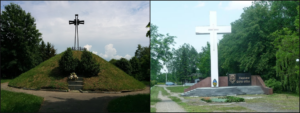
Zbaraž (Ternopilská oblasť) a osem ďalších miest – Významný vodca OUN Dmytro Kliachkivskyj (1911 – 1945), známy aj ako Klim Savur, zohral kľúčovú úlohu pri formovaní UPA v roku 1943. Kliachkivskyj sa nakoniec stal veliteľom okresu UPA-Sever, ktorý pôsobil v oblasti Volyne. Tam sa Kliachkivskyj stal jedným z organizátorov masakrov na Volyni – etnických čistiek v roku 1943, pri ktorých brutálne zahynulo 70 000 – 100 000 poľských civilistov, z ktorých mnohé boli deti. UPA zavraždila aj tisíce Židov.
Okrem pamätníka vo svojom rodnom meste Zbaraž má Kliačkivskij pamätník a ulicu v Rivne; pamätnú tabuľu na spoločnom pamätníku venovanom jemu a ďalším vodcom OUN v Moršine ; a ulice v Dubne (Rivnenská oblasť), Koroste, Kostopile, Lucku, Stryji a Ternopile.
Vľavo: pamätník Organizácie ukrajinských nacionalistov (OUN), Tenopil (Google Maps). Vpravo: pamätník „Hrdinovia OUN a UPA“ (UPA je skratka pre Ukrajinskú povstaleckú armádu), Bolechiv (Wikimapia). Obrázok od Forward collage
Ternopil a tri ďalšie lokality – Štyri pamätníky pripomínajúce OUN ako celok. Tyčiaci sa kríž na počesť „Hrdinov OUN a UPA“ (vpravo hore) sa nachádza v Bolechive, ktorý mal prosperujúcu populáciu 3 000 Židov; masakry spáchané nacistami a ukrajinskými kolaborantmi prežilo maximálne 50 z nich. Viac informácií o holokauste v Bolechive nájdete v knihe „Stratení: Hľadanie šiestich zo šiestich miliónov“ od Daniela Mendelsohna, v dokumente „ Susedia a vrahovia “ a v knihe Yahad-In Unum . Ďalšie dva pamätníky sa nachádzajú vo Vinnici a Volodymyr-Volynskom .
(Poznámka: Pamätníky Vinnytsia a Volodymyr-Volyns'kyi boli pridané v júni 2025.)
Pamätníky ukrajinských nacistických kolaborantov mimo Ukrajiny nájdete v sekciách USA , Kanada , Argentína , Nemecko , Spojené kráľovstvo , Rakúsko , Austrália a Taliansko .
Ukrajina takmer každý týždeň stavia nové pamätníky a tabule nacistickým kolaborantom. Eduard Dolinskij z Ukrajinského židovského výboru zaznamenáva túto explóziu zakrývania nacistických kolaborantov na Twitteri a písal o tom v New York Times . Viac informácií o ukrajinskom štátom sponzorovanom revizionizme holokaustu nájdete v článkoch The Nation , Foreign Policy , Open Democracy , tlačovej správe z amerického Múzea pamätníka holokaustu a na stránke Defending History venovanej Ukrajine .
Oprava: Pôvodný popis k fotografii stretnutia Jaroslava Stetska s vtedajším viceprezidentom USA Georgeom H. W. Bushom uvádzal nesprávny rok jej zhotovenia. Bol to rok 1983, nie 1943.
SÚVISIACE Vyšetrovanie: Približne 1 500 sôch a ulíc po celom svete – vrátane Nemecka a USA – ctí nacistov
Ternopil a tri ďalšie lokality – Štyri pamätníky pripomínajúce OUN ako celok. Tyčiaci sa kríž na počesť „Hrdinov OUN a UPA“ (vpravo hore) sa nachádza v Bolechive, ktorý mal prosperujúcu populáciu 3 000 Židov; masakry spáchané nacistami a ukrajinskými kolaborantmi prežilo maximálne 50 z nich. Viac informácií o holokauste v Bolechive nájdete v knihe „Stratení: Hľadanie šiestich zo šiestich miliónov“ od Daniela Mendelsohna, v dokumente „ Susedia a vrahovia “ a v knihe Yahad-In Unum . Ďalšie dva pamätníky sa nachádzajú vo Vinnici a Volodymyr-Volynskom .
(Poznámka: Pamätníky Vinnytsia a Volodymyr-Volyns'kyi boli pridané v júni 2025.)
Pamätníky ukrajinských nacistických kolaborantov mimo Ukrajiny nájdete v sekciách USA , Kanada , Argentína , Nemecko , Spojené kráľovstvo , Rakúsko , Austrália a Taliansko .
Ukrajina takmer každý týždeň stavia nové pamätníky a tabule nacistickým kolaborantom. Eduard Dolinskij z Ukrajinského židovského výboru zaznamenáva túto explóziu zakrývania nacistických kolaborantov na Twitteri a písal o tom v New York Times . Viac informácií o ukrajinskom štátom sponzorovanom revizionizme holokaustu nájdete v článkoch The Nation , Foreign Policy , Open Democracy , tlačovej správe z amerického Múzea pamätníka holokaustu a na stránke Defending History venovanej Ukrajine .
Oprava: Pôvodný popis k fotografii stretnutia Jaroslava Stetska s vtedajším viceprezidentom USA Georgeom H. W. Bushom uvádzal nesprávny rok jej zhotovenia. Bol to rok 1983, nie 1943.
SÚVISIACE Vyšetrovanie: Približne 1 500 sôch a ulíc po celom svete – vrátane Nemecka a USA – ctí nacistov
https://cutt.ly/3t3kYbFV
OdpovedaťOdstrániť